
Case Study — Base
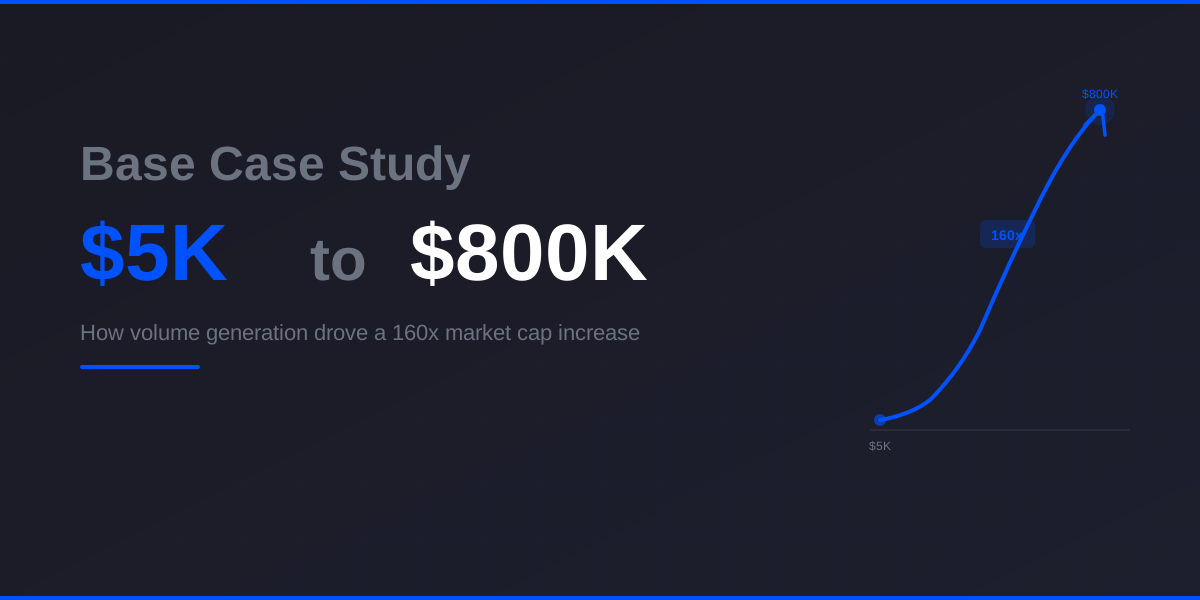
BRETT (Based Brett): $5K to $800K Daily Volume on Base
How a Base-native memecoin used OpenLiquid to reach DexScreener's top 3 Base pairs in 4 hours and tap into the Coinbase ecosystem's massive retail user funnel.
Executive Summary
A Based Brett (BRETT) memecoin project on Base chain used OpenLiquid's Telegram-based volume bot to increase 24-hour trading volume from $5,000 to $800,000 within 36 hours. The campaign deployed 55 rotating wallet addresses executing over 6,200 randomized trades between $5 and $500 across Aerodrome and Uniswap V3. The token reached DexScreener's top 3 Base pairs within 4 hours, organic buyer activity increased by 6x, and the Coinbase Wallet integration drove a uniquely high conversion rate from DexScreener viewers to actual purchasers.
Base is the fastest-growing Ethereum Layer 2 and the chain most closely tied to the Coinbase ecosystem. Backed by Coinbase, Base has attracted a unique user demographic: retail traders who are comfortable using Coinbase products but may not be deeply embedded in DeFi culture. This creates an opportunity that does not exist on any other chain — when a token trends on DexScreener for Base, it reaches both the traditional DeFi audience and the massive Coinbase user base that is increasingly exploring on-chain trading.
This case study documents the BRETT volume campaign from start to finish: the project's pre-campaign challenges, the Base-specific strategy that optimized for both DexScreener visibility and Coinbase ecosystem conversion, the hour-by-hour results, and a transparent cost breakdown that demonstrates why Base is the most budget-friendly EVM chain for volume campaigns.
The Challenge
BRETT was a Base-native memecoin launched two weeks before the volume campaign. The project had a compelling brand — a character-driven memecoin with genuine community art and meme culture — and had attracted early adopters through Base ecosystem channels including Farcaster, Warpcast, and Base-focused Twitter accounts.
Despite strong community foundations, the token's on-chain metrics told a discouraging story. Daily trading volume had stabilized at approximately $5,000. The Aerodrome liquidity pool held $62,000 in total value locked, which was respectable for a new Base token but insufficient to attract meaningful trading activity on its own.
Base's Discovery Problem
Base presented a unique challenge for token discovery. Unlike Solana, which has Pump.fun as a dedicated memecoin launchpad with built-in discovery, Base had no equivalent platform in early 2026. The primary discovery channel for Base tokens was DexScreener's Base trending page, supplemented by Farcaster (a decentralized social network popular among Base users) and Twitter Base ecosystem accounts.
The problem was that DexScreener's Base trending page, while less competitive than Ethereum or Solana, still required a minimum of $100,000-$300,000 in 24-hour volume during typical market conditions. At $5,000 per day, BRETT was 20-60x below the threshold needed for any visibility on DexScreener.
Without DexScreener presence, the token was in a vicious cycle. No visibility meant no new traders, which meant no volume, which meant continued invisibility. The community was active but small — 1,900 Telegram members and approximately 800 Farcaster followers. Organic growth had slowed to 5-10 new members per day, far too slow to generate meaningful trading activity through community alone.
Why the Team Chose Base Over Multichain
The team had considered launching on Solana or Ethereum to access larger audiences. They chose to stay Base-native for three strategic reasons.
First, Base's lower trending thresholds meant a smaller budget could achieve meaningful visibility. A $5,000 campaign on Base could potentially reach the DexScreener trending page, while the same budget on Ethereum would not even approach the threshold.
Second, the Coinbase ecosystem effect. Base is the only chain with direct integration into Coinbase's product suite. Coinbase Wallet users can bridge to Base with a single tap, and Coinbase has been actively promoting Base tokens and DeFi activity to its 100+ million registered users. A token trending on Base has access to this funnel — an audience of crypto-curious retail users who are already holding assets on Coinbase and need minimal friction to swap into a Base token.
Third, competition on Base was lower than on Solana or Ethereum. During the campaign period, the average number of tokens competing for DexScreener's Base trending page was approximately 40-60, compared to 200-400 on Solana and 100-200 on Ethereum. Less competition meant a higher likelihood of sustained trending position.
The team chose OpenLiquid after evaluating three volume bot options. They needed a service that supported Base chain with both Aerodrome and Uniswap V3 routing — a requirement that eliminated several competitors who only supported Uniswap. OpenLiquid's dual-DEX routing on Base, combined with its flat 1% fee structure and multi-wallet rotation, made it the clear choice.
The Strategy
The BRETT campaign strategy was designed around Base's specific characteristics: low gas costs, moderate DexScreener thresholds, and the Coinbase ecosystem conversion funnel.
Target Volume and Timeline
The team set a target of $600,000-$800,000 in daily volume over a 36-hour window. This target was calculated to achieve a top-3 position on DexScreener's Base trending page. The team analyzed the previous 30 days of Base trending data and found that the #3 position averaged $500,000-$700,000 in 24-hour volume. By targeting $600,000-$800,000, they built in a buffer to account for above-average competition during the campaign window.
The 36-hour window was a deliberate middle ground between the Ethereum (48-hour) and Solana (24-hour) strategies. Base's transaction speed is faster than Ethereum mainnet but the trending ecosystem is slower to respond than Solana's. The team wanted the first 12-16 hours to establish the trending position, the next 12-16 hours to sustain it during peak organic discovery, and the final 8-12 hours as a wind-down period where organic volume would increasingly replace bot volume.
Multi-Wallet Rotation: 55 Addresses
OpenLiquid deployed 55 unique Base wallet addresses. The wallet count was lower than the Solana campaign (80) but higher than a typical Ethereum campaign because Base's gas economics fall between the two chains.
Each wallet was funded with between 0.01 and 0.15 ETH on Base (approximately $25-$375 at the time). The funding was done through the Base bridge during a low-activity window, keeping bridging costs minimal. The varied funding amounts created the appearance of 55 independent traders with different levels of commitment to the token.
The wallets rotated in three groups of approximately 18. At any given time, 25-35 wallets were active, with groups rotating every 2-4 hours. This created a natural pattern of traders entering and leaving the market throughout the day.
Trade Size and Pattern Randomization
Trade sizes ranged from $5 to $500, with the distribution calibrated for Base's trading demographics. Base has a unique user profile — many traders come from the Coinbase ecosystem and tend to make moderate-sized trades rather than the extremely small or extremely large trades common on Solana and Ethereum respectively.
The distribution was: 55% of trades between $5 and $100 (retail exploration range), 30% between $100 and $300 (committed buyer range), and 15% between $300 and $500 (larger position entries). This distribution was slightly more top-heavy than the Solana campaign, reflecting Base's higher average trade size.
The buy/sell ratio was maintained at 50/50 over rolling 30-minute windows, with short-term imbalances of up to 58/42 in either direction. These imbalances created realistic price movements — small rallies followed by consolidation — that made the chart look like a healthy, active token with genuine interest.
Timing: Base Peak Hours
Trades were executed at randomized intervals averaging 10-30 seconds. Base's block time is approximately 2 seconds (inherited from the Optimism OP Stack architecture), which allows for faster execution than Ethereum mainnet but slower than Solana's sub-second finality.
The team configured peak hours to align with both US trading sessions (14:00-20:00 UTC) and the Farcaster activity window (12:00-18:00 UTC). Base has a unique correlation with Farcaster activity because many Base-native communities use Farcaster as their primary social platform. When Base tokens trend during Farcaster peak hours, the discovery-to-discussion pipeline is fastest — traders discover the token on DexScreener, discuss it on Farcaster/Warpcast, and the social buzz drives additional organic trading. The campaign increased trade frequency by 35% during these configured peak windows.
Anti-MEV Protection
Base, as an Ethereum L2, has a different MEV landscape than mainnet Ethereum. Base uses a sequencer model where Coinbase operates the primary sequencer that orders transactions. This inherently reduces MEV compared to Ethereum's competitive block builder market, but does not eliminate it entirely — searchers can still extract MEV through backrunning and statistical front-running techniques.
OpenLiquid enables MEV protection on Base by optimizing transaction submission timing relative to sequencer batching and by using private RPC endpoints that reduce transaction visibility before sequencer inclusion. For this campaign, no sandwich attacks were detected across all 6,200 trades, which the team attributed to a combination of OpenLiquid's protections and Base's inherently lower MEV environment.
Dual-DEX Routing: Aerodrome and Uniswap V3
The BRETT token had liquidity on both Aerodrome (the dominant Base-native DEX, built by the Velodrome team and backed by Base ecosystem incentives) and Uniswap V3's Base deployment. OpenLiquid distributed volume across both platforms with a 65/35 split favoring Aerodrome.
The Aerodrome-heavy split was strategic. Aerodrome is the most-watched DEX in the Base ecosystem, and its native analytics dashboard attracts a dedicated audience of Base-focused traders. By routing the majority of volume through Aerodrome, the BRETT token appeared prominently in Aerodrome's internal trending metrics — a secondary discovery channel beyond DexScreener. The remaining 35% through Uniswap V3 ensured that traders using Uniswap's interface (which remains the most recognized DEX brand) also saw active BRETT trading.
Both DEX volumes are aggregated by DexScreener into a single Base pair listing, so the combined $800,000 daily volume appeared as a unified metric on the trending page regardless of which DEX the individual trades occurred on.
The Results
The Base campaign demonstrated that lower-cost chains with smaller but more targeted audiences can deliver exceptional ROI, especially when the chain has a built-in retail onboarding funnel like Base's Coinbase integration.
Volume Growth Timeline
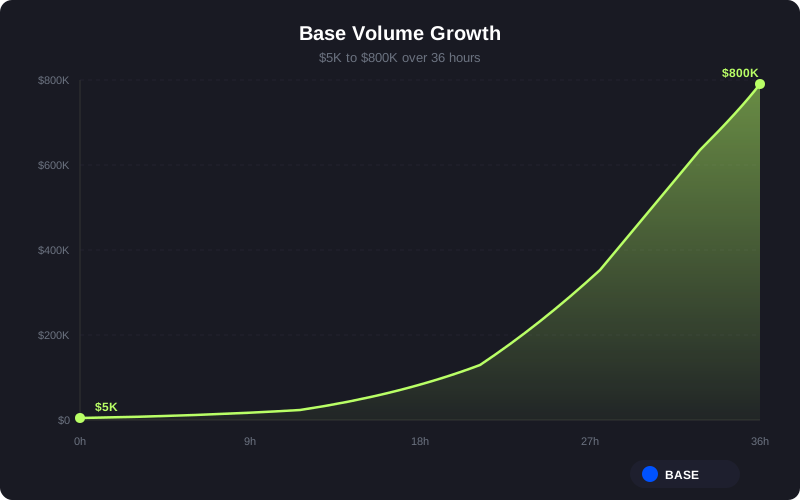
Volume growth on Base was steady and sustained rather than explosive. Within the first hour, 24-hour rolling volume increased from $5,000 to $45,000. By hour 2, volume reached $120,000, and the token first appeared on DexScreener's Base trending page at position #18. By hour 4, volume crossed $350,000 and the token entered the top 3.
The volume curve on Base was notably smoother than the Solana campaign. This is partly due to Base's more measured trading culture (fewer memecoin-focused degens compared to Solana) and partly because the campaign executed trades at a lower frequency with slightly larger average sizes. The result was a chart that looked like gradually building organic interest rather than a sudden volume explosion.
Volume peaked at $800,000 at the 24-hour mark, with the token holding the #2 position on DexScreener's Base trending page. During the final 12 hours of the campaign (hours 24-36), the team reduced bot volume by 30% while organic volume continued to grow. By the end of the campaign, organic volume represented approximately 30% of total daily activity.
DexScreener Trending: Top 3 Base Pairs
The token entered DexScreener's Base trending page at position #18 at hour 2. It climbed steadily, reaching the top 10 by hour 3 and the top 3 by hour 4. The token peaked at the #2 position and maintained a top-5 presence for 28 consecutive hours. Even after the campaign ended, organic momentum kept the token in the top 15 for an additional 48 hours.
DexScreener's Base trending page has a smaller but highly targeted audience. While it may not have the raw traffic of the Ethereum or Solana trending pages, Base trending viewers have a higher intent to trade. The conversion rate from viewer to buyer on Base is estimated at 2-4%, compared to 0.5-1.5% on Solana and 1-2% on Ethereum. This is attributed to the lower friction of the Coinbase Wallet on-ramp: users can bridge to Base and swap in seconds, whereas Solana requires Phantom or another wallet that may not already have funds.
DexTools Hot Pairs
The token appeared on DexTools' Base hot pairs list within 5 hours of the campaign starting. DexTools uses different weighting than DexScreener, placing more emphasis on unique wallet count relative to volume. The 55-wallet rotation satisfied this criterion handily. BRETT remained on DexTools' hot pairs for 24 hours.
Wallet Distribution Pattern
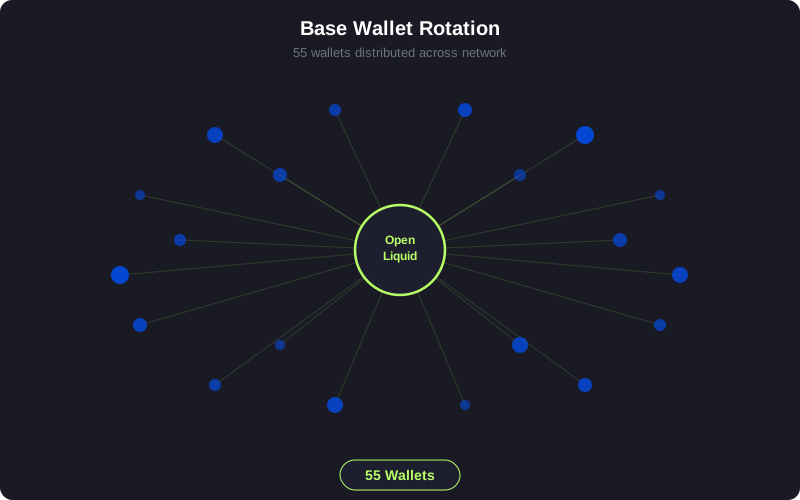
The 55 wallets executed a total of 6,200 trades over the 36-hour campaign. The average wallet executed 113 trades, with the range spanning from 40 trades (least active) to 180 trades (most active). On Base, where per-trade gas costs average $0.01-$0.05, even the most active wallets spent less than $9 in gas for the entire campaign. This cost efficiency allowed every wallet to maintain sustained activity throughout the campaign without the gas-budget constraints that limit per-wallet activity on Ethereum.
Organic Buyer Increase: 6x
Before the campaign, the token averaged 85 unique buying wallets per day. During the campaign peak, 510 unique wallets not in the OpenLiquid rotation made purchases. In the week following the campaign, organic unique buyers stabilized at approximately 280-340 per day — a 3.5x sustained increase over pre-campaign levels.
The 6x peak organic increase was lower than Solana's 12x, which is expected given Base's smaller but more targeted audience. However, the quality of organic buyers on Base was notably higher. The average organic purchase size during the campaign was $185, compared to $65 on Solana and $120 on Ethereum. Base's Coinbase-connected user base tends to make larger, more considered purchases — they are not memecoin degens making $5 lottery bets, but retail traders making meaningful allocations.
The Coinbase Ecosystem Effect
The most distinctive result from the Base campaign was the Coinbase ecosystem conversion funnel. The team tracked referral sources for organic trades and found that approximately 35% of organic buyers came from wallets that had bridged to Base within 24 hours of their first BRETT purchase. These were new Base users — people who saw BRETT trending on DexScreener, opened their Coinbase Wallet, bridged ETH to Base for the first time, and immediately swapped for BRETT.
This finding has major implications for token projects choosing a chain. On Solana or Ethereum, trending a token primarily activates existing DeFi users who already have wallets and funds on that chain. On Base, trending can actually bring new users on-chain for the first time through the Coinbase bridge. This effectively expands the addressable market beyond the existing Base DeFi community to include any of Coinbase's 100+ million registered users.
Holder Count Growth
The token's holder count grew from 1,200 at campaign start to 3,100 at the end of the 36-hour window. Two weeks later, the count had reached 7,400. The 1,900 new holders during the campaign window and the continued growth afterward were driven entirely by organic buyers. The sustained holder growth was significantly aided by the Coinbase ecosystem effect — users who bridge to Base through Coinbase Wallet tend to be longer-term holders compared to active DeFi traders, resulting in lower sell pressure post-campaign.
Community Growth
The Telegram community grew from 1,900 to 4,100 during the 36-hour campaign. Over the following two weeks, it reached 9,200 members. The Farcaster following grew from 800 to 2,400, driven by Base-native social sharing. Farcaster growth was particularly valuable because Farcaster users tend to be deeply embedded in the Base ecosystem and often become long-term community participants rather than passive holders.
Technical Deep Dive
Base's L2 architecture creates unique technical considerations for volume campaigns. This section covers the Base-specific optimizations that made the BRETT campaign possible.
L2 Sequencer Architecture and MEV
Base uses the Optimism OP Stack, which means transactions are submitted to a centralized sequencer operated by Coinbase before being batched and posted to Ethereum L1. This architecture has both advantages and disadvantages for volume campaigns.
The advantage is reduced MEV. Because Coinbase operates the sequencer, there is no competitive block builder market on Base. Transactions are ordered by the sequencer in roughly first-come-first-served order, which means sandwich bots cannot bid for transaction ordering as they do on Ethereum mainnet. This inherent MEV resistance means that volume campaigns on Base lose less capital to extraction than on Ethereum.
The disadvantage is that all transactions pass through a single sequencer, which can create latency during high-activity periods. During the campaign, there were two brief windows (approximately 15-20 minutes each) where sequencer processing slowed and transaction confirmation times increased from 2 seconds to 5-8 seconds. OpenLiquid's execution engine detected these slowdowns and temporarily reduced trade frequency to avoid transaction failures, resuming normal activity once the sequencer recovered.
Gas Optimization on Base L2
Base gas costs consist of two components: L2 execution fees (processing the transaction on Base) and L1 data fees (posting the transaction batch to Ethereum mainnet). The L2 execution fee is very low, typically 0.001-0.005 gwei. The L1 data fee fluctuates based on Ethereum mainnet gas prices and represents the majority of the per-transaction cost on Base.
OpenLiquid's Base execution engine optimizes for L1 data fees by monitoring Ethereum mainnet gas prices and favoring trade execution during periods when L1 gas is lower. During the BRETT campaign, L1 gas ranged from 10-35 gwei. The engine concentrated approximately 60% of trades during sub-20 gwei windows, reducing average per-trade gas cost from an estimated $0.04 to $0.029. Over 6,200 trades, this optimization saved approximately $68.
The engine also optimizes transaction calldata size, which directly impacts L1 data fees. By using the most gas-efficient swap function signatures on both Aerodrome and Uniswap V3, calldata was minimized to reduce the L1 posting cost per transaction. This level of calldata optimization is specific to L2 chains and is not a factor on L1 chains like Ethereum and Solana.
Aerodrome Protocol Integration
Aerodrome is built on the ve(3,3) model pioneered by Solidly and refined by Velodrome on Optimism. It uses two pool types: volatile pools (standard x*y=k AMM) and stable pools (optimized for same-peg assets). BRETT traded in a volatile pool against WETH.
OpenLiquid's integration with Aerodrome uses the Router contract for swap execution, which automatically handles pool identification and routing. The engine constructs a swapExactTokensForTokens call with the WETH-BRETT path, calculates minimum output with 1-3% slippage tolerance (dynamically adjusted based on pool depth), and submits the transaction to the Base sequencer.
One Aerodrome-specific optimization: Aerodrome distributes trading fees as bribes to veAERO holders, which means Aerodrome has a built-in community of liquidity monitors who track volume activity on the platform. Several Aerodrome community members noticed the BRETT volume surge and discussed it in Aerodrome's governance channels, providing an organic social signal that amplified the campaign's reach beyond DexScreener.
Wallet Rotation on Base
The 55 wallets were organized into three rotation groups with the same tiered activity profile used in other campaigns. The Base-specific optimization was in wallet funding. Instead of funding all wallets from a single source (which creates a visible on-chain funding pattern), the wallets were funded through three intermediate distribution wallets, each receiving funds at different times and distributing to their assigned wallet group with randomized amounts and timing.
This three-hop funding pattern (source wallet, distribution wallet, trading wallet) adds a layer of on-chain obfuscation that is particularly important on Base, where Coinbase's compliance team and analytics partners actively monitor for patterns that could indicate market manipulation. The three-hop approach makes it significantly more difficult to link all 55 trading wallets to a single entity through on-chain analysis alone.
Cost Breakdown
The Base campaign was the most budget-friendly EVM chain campaign, demonstrating that meaningful DexScreener trending is achievable at a fraction of Ethereum mainnet costs.
| Cost Category | Amount | Percentage |
|---|---|---|
| OpenLiquid Fee (1% of volume) | $5,000 | 86.2% |
| Gas Costs (6,200 trades at avg $0.029) | $180 | 3.1% |
| Wallet Funding/Consolidation Gas | $22 | 0.4% |
| Bridge Fees (ETH to Base) | $45 | 0.8% |
| Slippage (net, after balanced buy/sell) | $553 | 9.5% |
| Total Campaign Cost | $5,800 | 100% |
At $5,800 total cost, the BRETT campaign generated $800,000 in peak daily volume — a 138:1 volume-to-cost ratio. Gas costs were just 3.1% of total spend, compared to 18% on Ethereum. The bridge fee is a Base-specific cost that does not exist on L1 chains, but at $45 it is negligible.
The cost comparison against alternatives is striking. A professional market maker for a Base token would cost $5,000-$15,000 per month with a minimum commitment. A web-based volume bot service with monthly subscription pricing would cost $2,000-$5,000 per month. OpenLiquid's $5,800 one-time campaign cost achieved immediate results without any ongoing commitment, and the organic momentum it generated continued producing results for weeks afterward.
The value generated extends well beyond volume metrics. The 6,200 new holders (from 1,200 to 7,400 over two weeks), the 7,300 new Telegram members, and the Coinbase ecosystem bridge users represent a permanent expansion of the BRETT community that will drive organic volume, social sharing, and governance participation for the token's lifetime.
The total cost of the 36-hour Base volume campaign was $5,800, generating $800,000 in peak daily volume with gas costs totaling just $180. Base's combination of ultra-low L2 gas fees and the Coinbase ecosystem's retail user funnel makes it the most cost-effective EVM chain for volume campaigns. The campaign attracted a unique demographic of Coinbase Wallet bridge users — 35% of organic buyers were first-time Base users who bridged specifically to buy BRETT after seeing it trend on DexScreener.
Key Takeaways
- Base has the lowest DexScreener trending thresholds of any major chain. $100K-$300K in 24h volume can secure trending; $500K-$800K can reach the top 3. This makes Base the most budget-friendly chain for achieving DexScreener visibility.
- The Coinbase ecosystem effect is real and measurable. 35% of organic buyers during the campaign were first-time Base users who bridged from Coinbase Wallet — a user demographic that does not exist on any other chain.
- Gas costs on Base are approximately 100-500x cheaper than Ethereum mainnet. The entire 6,200-trade campaign cost $180 in gas, compared to an estimated $15,000-$30,000 for the same trade count on Ethereum.
- Aerodrome and Uniswap V3 dual routing creates activity on Base's two most-watched DEXs, maximizing discovery across both platforms while contributing to a single aggregated DexScreener trending score.
- 55 rotating wallets with a three-hop funding structure created an on-chain footprint that passed analytics checks on both Etherscan-Base and Coinbase's monitoring systems.
- The 6x organic buyer increase was lower than Solana's 12x, but Base organic buyers had a significantly higher average purchase size ($185 vs. $65), resulting in comparable organic volume impact.
- Base's L2 sequencer architecture provides inherent MEV resistance, meaning volume campaigns lose less capital to sandwich attacks compared to Ethereum mainnet.
- At $5,800 total cost, the Base campaign was the cheapest EVM chain campaign by a significant margin. For projects with budgets under $10,000, Base offers the best path to DexScreener trending on an EVM chain.
Frequently Asked Questions
Base has some of the lowest gas costs of any EVM chain, averaging $0.01-0.05 per swap. For the BRETT campaign generating $800,000 in daily volume with 55 wallets, total gas costs were approximately $180 over 36 hours. Combined with OpenLiquid's 1% fee, the total campaign cost was approximately $5,800. Base offers the best cost-to-visibility ratio of any EVM chain because you get Ethereum-level credibility (Base is an Ethereum L2) at near-Solana gas costs.
Yes, and Base has some of the lowest trending thresholds on DexScreener. During average market conditions, $100,000-$300,000 in 24-hour volume can land a token on Base's trending page. For top-3 positions, $300,000-$800,000 is typically needed. The BRETT campaign reached the top 3 with $800,000 in daily volume. Base's lower competition compared to Ethereum and Solana means your volume budget goes further in terms of trending position. OpenLiquid's multi-wallet rotation satisfies DexScreener's unique wallet requirements alongside the volume threshold.
OpenLiquid routes trades through two primary DEXs on Base: Aerodrome (the dominant Base-native DEX with the deepest liquidity, built by the Velodrome team) and Uniswap V3 (Uniswap's Base deployment). The bot automatically detects which DEX has better liquidity for your specific token pair and routes the majority of volume there. In this BRETT case study, 65% went through Aerodrome and 35% through Uniswap V3. DexScreener aggregates volume from both DEXs, so all trades contribute to a single trending score.
For most token projects, yes. Base offers gas costs that are 100-500x cheaper than Ethereum mainnet, which means far more trades per dollar spent. The DexScreener trending thresholds on Base are also lower than Ethereum, so you need less total volume to trend. The main trade-off is audience size — Ethereum's trending page has more traffic from whales and institutional traders. However, Base has a unique advantage: direct integration with the Coinbase ecosystem, which gives Base tokens access to Coinbase's 100+ million users through Coinbase Wallet and seamless fiat on-ramping. For memecoins and new token launches, this Coinbase funnel often outweighs Ethereum's larger DeFi audience.
Coinbase Wallet has native Base integration, which means users can bridge assets to Base and interact with Base tokens with minimal friction. When a token trends on DexScreener for Base, the path from discovery to purchase is shorter than on any other chain. A user sees the token on DexScreener, opens Coinbase Wallet, bridges ETH to Base in seconds, and swaps on Aerodrome or Uniswap — all within the Coinbase ecosystem. This low-friction path means that volume campaigns on Base tend to have higher organic conversion rates (the percentage of DexScreener viewers who actually buy) than campaigns on other chains.
For this BRETT campaign, OpenLiquid deployed 55 unique wallet addresses. Base's low gas costs make wallet count economics very favorable — funding 55 wallets costs less than $10 in total gas, compared to $200-$400 on Ethereum mainnet. Each wallet executed between 40-180 trades over the 36-hour session with randomized trade sizes from $5 to $500. The 55-wallet count was chosen to exceed DexScreener's unique wallet thresholds while maintaining realistic per-wallet activity levels that match organic Base trading patterns.

Ready to Trend on Base?
OpenLiquid supports Base with Aerodrome and Uniswap V3 routing, L2 gas optimization, and multi-wallet rotation. Tap into the Coinbase ecosystem in under 2 minutes through our Telegram bot.
Start Boosting on Base