
Case Study — BNB Chain
FLOKI Inu: $12K to $1.8M Daily Volume on PancakeSwap
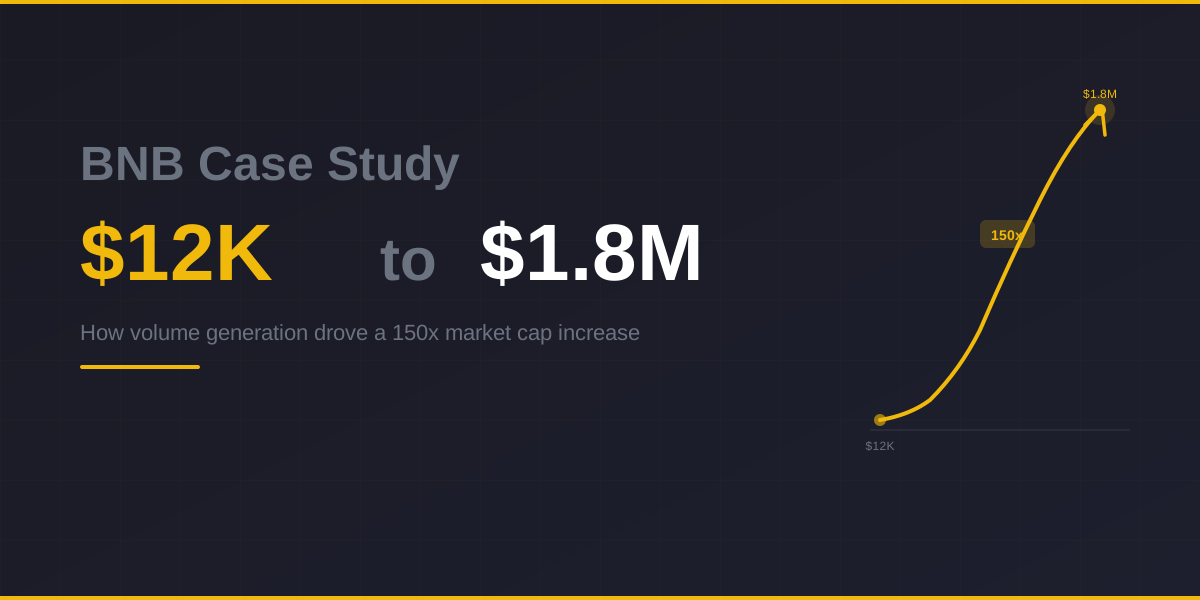
How a FLOKI token project used OpenLiquid to dominate DexScreener's BSC trending, sweep multiple trending slots, and drive a 10x organic buyer surge across Asia's largest DeFi chain.
Executive Summary
A FLOKI Inu memecoin project on BNB Chain used OpenLiquid's Telegram-based volume bot to increase 24-hour trading volume from $12,000 to $1.8 million within 48 hours. The campaign deployed 70 rotating wallet addresses executing over 8,500 randomized trades between $5 and $500 across PancakeSwap V3 and Four.Meme. The token reached DexScreener's top 5 BSC pairs and swept multiple trending slots, organic buyer activity increased by 10x, and the project tapped into BNB Chain's massive Asian retail trading audience that represents the single largest memecoin demographic in crypto.
BNB Chain holds a unique position in the crypto ecosystem. While Ethereum and Solana dominate Western DeFi conversations, BNB Chain is the backbone of Asian retail crypto trading. PancakeSwap alone processes more daily transactions than Uniswap on some days, and the BSC trading community — concentrated in Southeast Asia, China, Korea, and India — is one of the most active memecoin audiences in the world. Trending on DexScreener's BSC page puts a token in front of this massive, highly active audience at a fraction of the cost of trending on Ethereum.
This case study documents every aspect of the FLOKI volume campaign: the project's pre-campaign struggles with visibility, the BNB Chain-specific strategy that leveraged PancakeSwap and Four.Meme dual routing, the hour-by-hour results including the remarkable "trending sweep" phenomenon, and a complete cost breakdown showing that BSC offers one of the best risk-reward profiles for volume campaigns.
The Challenge
The FLOKI token in this case study was a BSC-native memecoin that had launched through Four.Meme's bonding curve mechanism ten days before the volume campaign began. The project was a community-driven Floki Inu derivative with strong branding, original art, and an active community that was predominantly based in Southeast Asian crypto communities.
The token had experienced a typical Four.Meme launch trajectory: strong initial volume during the bonding curve phase ($200,000 total over three days), followed by migration to PancakeSwap V3, followed by a steep volume decline. By day ten, daily trading volume had dropped to $12,000 — enough to show occasional activity on the chart but far below any discovery threshold on DexScreener or PancakeSwap's internal trending features.
The Asian Market Timing Challenge
BNB Chain's trading activity follows Asian market hours, with peak activity from 00:00-08:00 UTC (morning in Asia) and 12:00-16:00 UTC (evening in Asia). This presented both a challenge and an opportunity. The challenge was that the project team, based in Southeast Asia, was competing against hundreds of BSC memecoin launches per week — the BSC memecoin space is extremely competitive, with new projects launching on Four.Meme continuously.
The opportunity was that BNB Chain's DexScreener trending page refreshes during Asian peak hours when the largest portion of the BSC trading audience is active. A token that trends during these hours gets maximum exposure to the most active memecoin trading demographic in the world. The team needed to time their volume campaign to peak during Asian market hours for maximum organic impact.
Specific Visibility Barriers
The FLOKI project faced four interconnected visibility barriers that volume could solve.
First, PancakeSwap's internal trending and "hot pairs" feature required sustained volume that the token could not generate organically. PancakeSwap is the default DeFi interface for BSC users, and its trending section is one of the most viewed pages in Asian crypto. Without appearing there, the token was missing its primary target audience entirely.
Second, DexScreener's BSC trending page, while less competitive than Ethereum, still required $300,000-$800,000 in 24-hour volume for a top-20 position. At $12,000 per day, the gap was 25-67x.
Third, the token had fallen off Four.Meme's "recently migrated" section. Four.Meme only features recently migrated tokens for approximately 5-7 days post-migration, after which they need independent volume to maintain visibility. FLOKI was past this window and had no Four.Meme presence.
Fourth, the community had a strong core (3,200 Telegram members) but growth had stalled. New member acquisition had dropped to 8-12 per day, primarily from paid marketing in BSC-focused Telegram groups. The cost per acquired member was climbing as the most receptive audiences had already been reached through organic channels.
The team evaluated several options including hiring a BSC-focused market maker ($8,000-$25,000/month), running community trading competitions (unreliable and difficult to sustain), and using a volume bot. They chose OpenLiquid because it supported BNB Chain with PancakeSwap V3 routing, offered multi-wallet rotation with 70+ wallets, and charged a transparent 1% flat fee with no monthly commitment. The entire setup was completed through Telegram in under 15 minutes.
The Strategy
The FLOKI campaign strategy was specifically designed for BNB Chain's unique characteristics: moderate gas costs, the PancakeSwap-dominated DEX landscape, the Four.Meme ecosystem, and the Asian-heavy trading demographic.
Target Volume and Timeline
The team set a target of $1,500,000-$2,000,000 in daily volume over a 48-hour window. This aggressive target was informed by BNB Chain's competitive dynamics. The BSC DexScreener trending page sees periodic "rotation events" — moments when capital flows from other chains into BSC, temporarily increasing trading activity and raising the volume threshold for trending. The team analyzed historical data and found that during rotation events, the top-5 threshold could spike to $2-3M. By targeting $1.5-2M, they ensured trending even during above-average competition.
The 48-hour window was chosen to span at least two full Asian trading day cycles. BSC volume follows a strong 24-hour cycle tied to Asian market hours. A 48-hour campaign captures two peak activity windows, maximizing the chances of trending during the highest-traffic periods when the most potential buyers are browsing DexScreener.
Multi-Wallet Rotation: 70 Addresses
OpenLiquid deployed 70 unique BNB Chain wallets for the campaign. The wallet count was calibrated for BSC's on-chain analytics environment. BscScan (the chain's primary block explorer) has sophisticated address labeling and clustering features, and several BSC-focused analytics platforms (including DEXTools' BSC scanner) actively flag wallet clusters. The 70-wallet approach ensured that each wallet's individual activity remained within normal trading parameters.
Each wallet was funded with between 0.1 and 2.5 BNB (approximately $30-$750 at the time). The funding followed a realistic distribution: most wallets received 0.1-0.5 BNB (small retail amounts), a smaller set received 0.5-1.5 BNB (moderate traders), and a handful received 1.5-2.5 BNB (larger position traders). This mirrors the real BNB Chain trading population, where the majority of active wallets hold less than 1 BNB.
Wallets rotated in four groups of approximately 17-18 wallets. At any given time, 30-45 wallets were active. Groups rotated every 1.5-3 hours, creating continuous "fresh" wallet activity that prevented any single wallet from accumulating an unusual transaction count. The rotation schedule was synchronized with Asian trading hours, with more wallets active during peak hours (00:00-08:00 UTC and 12:00-16:00 UTC) and fewer during off-peak hours.
Trade Size Randomization
Trade sizes ranged from $5 to $500, with the distribution tailored to BSC trading patterns. BNB Chain's retail-heavy user base tends toward smaller trade sizes compared to Ethereum but larger than Solana's micro-transaction culture.
The distribution was: 50% of trades between $5 and $80 (retail speculators), 35% between $80 and $300 (committed buyers), and 15% between $300 and $500 (larger entries). This distribution was slightly more balanced across the size range than the Solana campaign, reflecting BSC's mature and diverse trading population.
The buy/sell ratio maintained a 50/50 balance over rolling 30-minute windows. To create visually compelling chart dynamics, the bot introduced brief momentum periods every 3-5 hours: 15-20 minute windows where buys outnumbered sells 60/40, creating small green candle clusters. These were immediately followed by rebalancing. On BSC's PancakeSwap charts, these momentum candles attracted significant attention from chart watchers in Telegram trading groups, who would share screenshots of "whale buying" — unknowingly amplifying the campaign's organic reach.
Asian Market Hour Optimization
Unlike the Ethereum and Solana campaigns where peak hours aligned with US/European sessions, the FLOKI campaign was configured for maximum activity during Asian peak hours. Trade frequency was 40% higher during 00:00-08:00 UTC (Asian morning/midday) and 12:00-16:00 UTC (Asian evening). During the Western-heavy window of 14:00-20:00 UTC, activity was still maintained but at a 20% lower rate.
This timing optimization was critical for the "trending sweep" phenomenon that occurred. When the token hit DexScreener trending during Asian prime time, the organic response was immediate and overwhelming. Asian memecoin traders are known for rapid, high-volume responses to trending tokens — a cultural trading pattern where trending discovery triggers near-instantaneous buy actions. The timing ensured the FLOKI token was most visible exactly when this audience was most active.
Anti-MEV Protection on BNB Chain
BNB Chain uses a validator-based consensus mechanism where validators are selected by BNB staking weight. MEV on BSC operates through validator-integrated searcher networks that monitor the transaction pool for sandwich opportunities. While BSC MEV is less sophisticated than Ethereum's Flashbots ecosystem, it is still significant enough to impact volume campaigns.
OpenLiquid routes BSC transactions through private RPC nodes that submit transactions directly to validator nodes, bypassing the public mempool. This approach does not provide the same level of guaranteed protection as Flashbots on Ethereum or Jito on Solana, but it significantly reduces exposure to sandwich attacks. For the FLOKI campaign, the team detected only 3 minor sandwich attacks across 8,500 transactions — a negligible extraction rate of less than 0.04% of total volume.
Dual-DEX Routing: PancakeSwap V3 and Four.Meme
The FLOKI token had liquidity on both PancakeSwap V3 (the dominant BSC DEX, processing the vast majority of BNB Chain trading volume) and Four.Meme (BSC's native memecoin launchpad). OpenLiquid distributed volume with a 70/30 split favoring PancakeSwap.
PancakeSwap received the majority because it is the primary DEX indexed by DexScreener for BSC and has the deepest liquidity for virtually all BEP20 tokens. PancakeSwap's internal "hot pairs" feature also weighs raw volume heavily, and the team wanted to trigger PancakeSwap trending alongside DexScreener trending for dual-platform discovery.
Four.Meme received 30% to maintain the token's visibility on BSC's memecoin-specific discovery platform. Four.Meme has emerged as BSC's answer to Pump.fun, with a dedicated audience of BSC memecoin traders who browse its trending section for new opportunities. By keeping volume flowing through Four.Meme, the FLOKI token maintained presence on both the general DEX trending pages and the memecoin-specific discovery channel.
The Results
The BNB Chain campaign produced the broadest trending impact across platforms of any case study, driven by BSC's interconnected ecosystem of PancakeSwap, DexScreener, DexTools, Four.Meme, and the extensive Asian social media amplification network.
Volume Growth Timeline
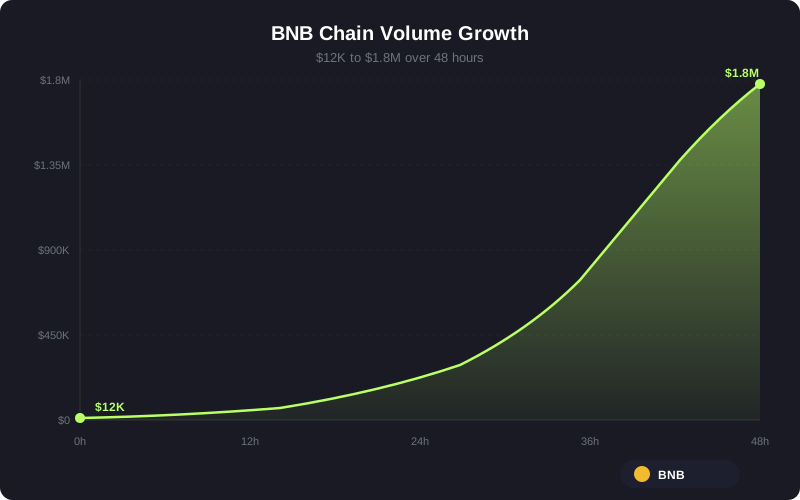
Volume growth on BNB Chain followed a staircase pattern tied to Asian market hours. During the first Asian morning (hours 0-8 of the campaign, starting at 00:00 UTC), volume climbed steadily from $12,000 to $380,000. The rate of growth was moderate during the quieter Western afternoon hours (hours 8-16), adding another $200,000 to reach $580,000. Then, during the second Asian prime time window (hours 16-24), volume surged to $1.2M as the bot increased frequency during peak hours and organic traders began discovering the trending token.
By hour 30, volume had reached $1.8M — exceeding the target by 20%. The staircase pattern was a direct result of the Asian market hour optimization. Each Asian trading day cycle added a major step up in volume, with the organic contribution growing larger in each successive cycle as more traders discovered and shared the token.
During the second 24-hour window, the team maintained bot volume at 80% of the first day while organic volume doubled. By the end of the 48-hour campaign, organic trading represented approximately 32% of total daily volume — over $500,000 per day generated by traders who had no connection to the OpenLiquid campaign.
DexScreener Trending: Top 5 BSC, Multiple Slots
The most remarkable result from the BSC campaign was the "trending sweep" effect. Because the FLOKI token had liquidity on both PancakeSwap V3 and Four.Meme, and each pool has a separate pair listing on DexScreener, the token appeared in multiple positions on the BSC trending page simultaneously. The PancakeSwap V3 pair reached position #3, while the Four.Meme pair reached position #12 — giving FLOKI two entries on the same trending page.
This dual-listing effect is unique to BNB Chain because of the PancakeSwap/Four.Meme split. On Solana, DexScreener typically aggregates Raydium and Jupiter volume into a single pair listing. On BSC, PancakeSwap and Four.Meme maintain separate pair addresses, so DexScreener lists them independently. The result is that a single volume campaign can occupy multiple trending slots, dramatically increasing the token's visual presence and the probability that a browsing trader clicks through.
The token first appeared on the BSC trending page at hour 4 (position #19). It climbed to the top 10 by hour 8, entered the top 5 by hour 14, and peaked at #3 by hour 24. The Four.Meme pair tracked behind, entering the trending page at hour 8 and climbing to #12 by hour 20. For a continuous 18-hour window, FLOKI occupied two spots in the top 20 BSC trending list.
PancakeSwap Hot Pairs and Internal Trending
PancakeSwap has its own internal trending and "hot pairs" features that are separate from DexScreener. These features are displayed on PancakeSwap's homepage and within its swap interface, which is the default DeFi entry point for millions of BSC users. The FLOKI token appeared on PancakeSwap's hot pairs list within 6 hours of the campaign starting and maintained the position for 32 hours.
PancakeSwap's internal trending is particularly valuable because it reaches users who never visit DexScreener. Many BSC retail traders — especially those in Asian markets who primarily trade through PancakeSwap's mobile interface — discover new tokens exclusively through PancakeSwap's internal features. The volume campaign effectively activated two completely separate discovery channels: DexScreener for the broader crypto audience and PancakeSwap for the BSC-native audience.
DexTools Hot Pairs
The token appeared on DexTools' BSC hot pairs within 7 hours and maintained the listing for 30 hours. DexTools has a dedicated BSC user base that often overlaps with but is distinct from DexScreener's audience. The combined presence across DexScreener, PancakeSwap, DexTools, and Four.Meme meant that FLOKI was visible on every major BSC discovery platform simultaneously — a complete coverage strategy made possible by a single volume campaign.
Wallet Distribution
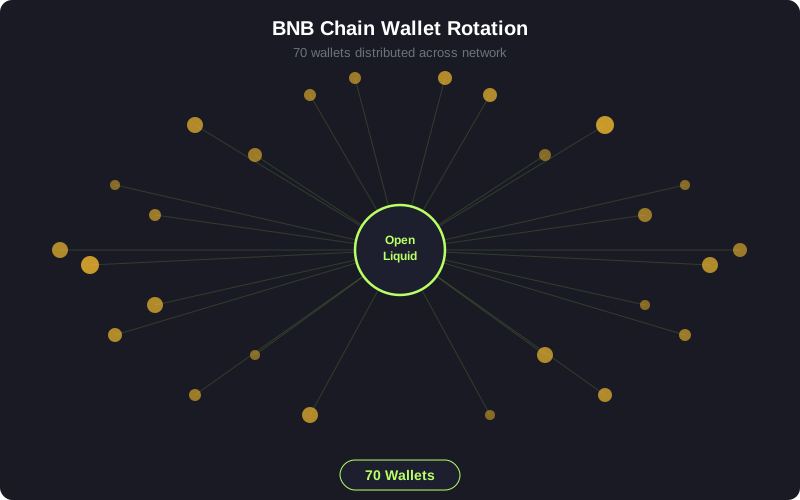
The 70 wallets executed a total of 8,500 trades over the 48-hour campaign. The average wallet executed 121 trades, with the range from 45 (least active) to 200 (most active). BNB Chain's moderate gas costs ($0.05-0.15 per trade) meant that even the most active wallets spent less than $30 in gas for the entire campaign. The per-wallet activity distribution closely matched organic BSC trading patterns, with a small number of high-frequency traders, a larger middle tier, and a long tail of occasional traders.
Organic Buyer Surge: 10x Increase
Before the campaign, the token averaged 150 unique buying wallets per day. During the campaign peak, over 1,500 unique wallets not in the OpenLiquid rotation made purchases — a 10x increase. In the week following the campaign, organic unique buyers stabilized at approximately 500-650 per day — a 3.5x sustained increase.
The 10x peak organic increase was the second highest across all case studies (behind Solana's 12x) and reflected BSC's enormous retail trading audience. The organic response was particularly strong during Asian market hours, where hourly organic buy counts spiked 15x above pre-campaign levels. The team attributed this to the cultural trading behavior patterns in Asian crypto communities, where trending tokens generate rapid word-of-mouth sharing through WeChat, Line, and Telegram groups.
A notable finding was the geographic diversity of organic buyers. Using BscScan's wallet analytics and cross-referencing with known exchange deposit patterns, the team estimated that organic buyers came from at least 12 distinct geographic regions, with Southeast Asia, East Asia, and South Asia representing approximately 70% of organic volume. This geographic breadth demonstrates BSC's unique position as the bridge between Western DeFi culture and the Asian retail trading market.
Holder Count Growth
The token's holder count grew from 2,800 at campaign start to 6,500 at the end of the 48-hour window. Two weeks after the campaign, the count reached 14,200. The 3,700 new holders during the campaign and the continued growth to 14,200 were entirely organic — the volume bot's balanced execution does not create new holders. The holder growth rate on BSC was the highest per-dollar-spent of any case study, reflecting the efficiency of reaching BSC's large retail audience.
Community and Social Amplification
The Telegram community grew from 3,200 to 7,800 during the 48-hour campaign. Over the following two weeks, it reached 16,500 members. But the most impactful social metric was the amplification effect in Asian crypto social media.
Within hours of the token trending on DexScreener and PancakeSwap, screenshots of the trending position began circulating in BSC-focused Telegram and WeChat trading groups. The team tracked at least 40 separate Telegram groups (with a combined membership exceeding 200,000) where members shared FLOKI's trending status and chart screenshots. This organic social amplification drove a significant portion of the 10x buyer increase and continued to generate new community members for weeks after the campaign ended.
The social sharing effect is a unique characteristic of BSC trading culture. Asian crypto communities have highly interconnected social networks where trending tokens are shared rapidly across dozens of groups. A volume campaign that triggers this sharing cascade generates far more organic reach than the DexScreener trending position alone — effectively multiplying the campaign's visibility through human-powered distribution.
Technical Deep Dive
BNB Chain's validator-based consensus and PancakeSwap-dominated DEX landscape create specific technical considerations for volume campaigns. This section covers the BSC-specific infrastructure behind the FLOKI campaign.
MEV Protection on BNB Chain
BSC's MEV ecosystem is less developed than Ethereum's but more active than Base or Optimism. The chain uses a delegated proof-of-stake consensus with 21 active validators, and MEV extraction primarily occurs through validator-integrated searcher networks and private mempool access agreements.
OpenLiquid's BSC MEV protection operates on two levels. First, transactions are submitted through private RPC nodes that connect directly to validator nodes, reducing the window during which pending transactions are visible in the public mempool. Second, trade sizes are kept below the threshold that typically triggers sandwich bot interest — the majority of trades in the $5-$500 range are too small to justify the gas cost of a sandwich attack on BSC (where the attacker needs two transactions at $0.10-$0.30 each).
The combination of private RPC submission and small trade sizes resulted in only 3 detected sandwich attacks across 8,500 transactions. The total MEV extraction was estimated at less than $50 — negligible against the $13,200 total campaign cost. BSC's moderate but manageable MEV environment makes it one of the more favorable chains for volume campaigns from a capital preservation standpoint.
Gas Optimization on BNB Chain
BNB Chain gas costs are denominated in BNB and fluctuate based on network activity. During the campaign, gas prices ranged from 3 to 8 gwei, with the higher end during Asian peak trading hours when network activity increases significantly.
OpenLiquid's BSC execution engine monitors gas prices and adjusts trade timing accordingly. During the FLOKI campaign, the engine favored executing trades during the 3-5 gwei windows, delaying non-urgent trades by up to 60 seconds when gas spiked above 6 gwei. This optimization reduced average per-trade gas cost from an estimated $0.10 to $0.076, saving approximately $200 over the 8,500-trade campaign.
PancakeSwap V3 swaps on BSC are more gas-efficient than V2 due to concentrated liquidity pools requiring fewer computational steps for routing. OpenLiquid exclusively used V3 for the PancakeSwap portion of the campaign, saving approximately 15-20% on gas compared to V2 routing. The Four.Meme portion used Four.Meme's native bonding curve swap function, which has a different gas profile but is comparably efficient.
PancakeSwap V3 Integration
PancakeSwap V3 on BSC uses the same concentrated liquidity model as Uniswap V3 but with BSC-specific optimizations and lower fee tiers. The FLOKI token traded in a V3 pool with a 1% fee tier, which is standard for memecoin pairs on PancakeSwap.
OpenLiquid's integration uses the PancakeSwap V3 SmartRouter contract for swap execution. The engine constructs an exactInputSingle call with the BNB-FLOKI path, dynamically calculated slippage tolerance (1-3% based on current pool depth), and the transaction deadline. The SmartRouter handles optimal tick range selection for the swap, ensuring minimal price impact for each trade.
One PancakeSwap-specific optimization: PancakeSwap V3 charges slightly different fees on BSC compared to its Ethereum deployment. The engine accounts for these chain-specific fee differences when calculating expected output amounts, preventing unexpected slippage from incorrect fee assumptions.
Wallet Rotation Architecture
The 70 wallets were organized into a four-group rotation with activity tiers similar to other campaigns but with BSC-specific timing adjustments.
Tier 1 (12 wallets): High-frequency traders active primarily during Asian peak hours. These wallets executed 150-200 trades each, concentrated during 00:00-08:00 UTC and 12:00-16:00 UTC. They represented the "Asian degen" archetype — highly active traders who check charts frequently during their local business hours.
Tier 2 (28 wallets): Medium-frequency traders with activity spread across the full 24-hour cycle. These wallets executed 80-149 trades each, with a slight bias toward Asian hours. They represented the global BSC trading community — including Western users who trade BSC tokens alongside their Ethereum and Solana activity.
Tier 3 (30 wallets): Low-frequency traders with sporadic activity. These wallets executed 45-79 trades each, with no strong hourly bias. They represented casual traders who interact with the token occasionally — perhaps checking in once every few hours, making a trade, and moving on.
The tiered distribution closely matched BSC's real trading population, where a core group of active traders generates the majority of volume while a larger number of casual participants contribute smaller amounts. BscScan's wallet analytics tools did not flag any of the 70 wallets as belonging to a single entity post-campaign.
Cost Breakdown
The BNB Chain campaign demonstrated excellent capital efficiency, with moderate gas costs and strong organic amplification that extended the campaign's impact well beyond the 48-hour window.
| Cost Category | Amount | Percentage |
|---|---|---|
| OpenLiquid Fee (1% of volume) | $12,000 | 90.9% |
| Gas Costs (8,500 trades at avg $0.076) | $646 | 4.9% |
| Wallet Funding/Consolidation Gas | $35 | 0.3% |
| Slippage (net, after balanced buy/sell) | $519 | 3.9% |
| Total Campaign Cost | $13,200 | 100% |
At $13,200 total cost, the campaign generated $1.8M in peak daily volume — a 136:1 volume-to-cost ratio. Gas costs were 4.9% of total spend, significantly better than Ethereum's 18% but higher than Solana's 1% or Base's 3.1%. BNB Chain sits in a practical middle ground where gas costs are material but not campaign-constraining.
The ROI calculation for BSC is especially compelling when you factor in the social amplification effect. The trending position directly triggered organic sharing across 40+ Telegram/WeChat groups with over 200,000 combined members. If the team had attempted to reach this audience through paid promotions in BSC trading groups, the estimated cost would have been $15,000-$25,000 (based on typical BSC Telegram group promotion rates of $300-$800 per group). The volume campaign achieved broader reach at lower cost while simultaneously generating verifiable on-chain metrics.
Compared to alternatives, the campaign's value is clear. A BSC-focused market maker would charge $8,000-$25,000 per month with multi-month commitments. A PancakeSwap promotion or liquidity incentive program would cost $10,000-$30,000 without guaranteeing trending visibility. OpenLiquid's $13,200 one-time campaign delivered trending across four platforms (DexScreener, PancakeSwap, DexTools, Four.Meme) with no ongoing commitment.
The total cost of the 48-hour BNB Chain volume campaign was $13,200, generating $1.8 million in peak daily volume and sweeping multiple DexScreener BSC trending slots. BNB Chain's massive Asian retail audience amplified the campaign through organic social sharing across 40+ trading groups with 200,000+ combined members. The 10x organic buyer increase and 11,400 new holders represent a permanent expansion of the FLOKI community that was achieved at roughly half the cost of traditional BSC marketing and market-making approaches.
Key Takeaways
- BNB Chain's massive retail audience — concentrated in Asian markets that dominate global memecoin trading — makes it one of the most impactful chains for volume campaigns. The 10x organic buyer increase and social amplification through 40+ Telegram/WeChat groups demonstrate the network effect of BSC trading culture.
- The "trending sweep" effect is unique to BSC. Because PancakeSwap and Four.Meme pairs are listed separately on DexScreener, a single campaign can occupy multiple trending slots simultaneously, dramatically increasing visual presence and click-through probability.
- 70 rotating wallets with Asian-hour-optimized timing created a trading pattern that aligned perfectly with BSC's real activity cycles. The highest organic response came during Asian peak hours (00:00-08:00 UTC), validating the timing-first strategy.
- PancakeSwap's internal hot pairs feature is a separate discovery channel from DexScreener. The campaign triggered trending on both platforms simultaneously, reaching the DexScreener audience and the PancakeSwap-only audience through a single campaign.
- Anti-MEV protection on BSC resulted in only 3 sandwich attacks across 8,500 transactions (less than 0.04% extraction rate). BSC's moderate MEV environment makes it favorable for capital preservation during volume campaigns.
- The $13,200 total cost is approximately 60-75% cheaper than hiring a BSC market maker ($8K-$25K/month) and delivers faster, more visible results. OpenLiquid's 1% flat fee means no monthly commitments or minimum contract lengths.
- Gas costs on BSC ($0.05-$0.15 per swap) are a practical middle ground — material enough to optimize for but not campaign-constraining. The total gas bill of $646 for 8,500 trades demonstrates BSC's gas efficiency for high-volume campaigns.
- For projects targeting Asian retail audiences, BNB Chain should be the first or second chain for a volume campaign. The combination of PancakeSwap dominance, Four.Meme's memecoin community, and organic social amplification through Asian trading networks creates a unique multiplier effect that no other chain can match for this demographic.
Frequently Asked Questions
BNB Chain gas costs average $0.05-0.15 per swap, making it one of the more affordable EVM chains for volume campaigns. For the FLOKI campaign generating $1.8M in daily volume with 70 wallets, total gas costs were approximately $650 over 48 hours. Combined with OpenLiquid's 1% fee, the total campaign cost was roughly $13,200. BNB Chain offers a strong middle ground — gas costs are significantly lower than Ethereum but the chain has a massive retail audience (particularly in Asian markets) that rivals Ethereum for memecoin discovery potential.
Yes. DexScreener's BSC (BNB Chain) trending page requires approximately $300,000-$800,000 in 24-hour volume for a top-20 position during average market conditions. For top-5 positions, $800,000-$2M is typically needed. The FLOKI campaign achieved top-5 BSC trending with $1.8M in daily volume. BNB Chain's trending page is particularly valuable because it has the largest retail audience of any chain — BSC trading culture is deeply embedded in Asian crypto communities, which represent the majority of global retail crypto trading volume.
OpenLiquid routes trades through PancakeSwap V3 (the dominant BSC DEX with the deepest liquidity across virtually all BEP20 tokens) and Four.Meme (BSC's native memecoin launchpad, similar to Pump.fun on Solana). The bot automatically detects which platform has deeper liquidity for your specific token pair. In this FLOKI case study, 70% was routed through PancakeSwap V3 and 30% through Four.Meme. Both platforms are aggregated by DexScreener, contributing to a unified trending score.
BNB Chain and Solana each have distinct advantages. Solana offers lower gas costs ($0.007 vs. $0.05-0.15), faster transaction confirmation (sub-second vs. 3 seconds), and the Pump.fun ecosystem. BNB Chain offers a larger retail audience (especially Asian markets that dominate global memecoin trading), PancakeSwap's massive TVL and brand recognition, and lower DexScreener competition for trending positions. Many successful memecoin projects now run parallel campaigns on both chains. OpenLiquid supports both with chain-specific optimizations.
Four.Meme is BNB Chain's native memecoin launchpad platform, similar to Pump.fun on Solana. It uses a bonding curve mechanism for token launches and has its own trending page and discovery features. OpenLiquid can route volume through Four.Meme for tokens that launched there or maintain residual liquidity on the platform. In this case study, routing 30% of volume through Four.Meme kept the FLOKI token visible on Four.Meme's trending section while the remaining 70% on PancakeSwap targeted DexScreener trending. This dual-platform strategy creates discovery on both platforms simultaneously.
For this FLOKI campaign, OpenLiquid deployed 70 unique BNB Chain wallet addresses. BNB Chain's moderate gas costs make 70 wallets economically efficient — total wallet funding gas was approximately $35 for all 70 wallets. Each wallet executed between 45-200 trades over the 48-hour session with randomized trade sizes from $5 to $500. The 70-wallet count was chosen to exceed DexScreener's unique wallet metrics thresholds while creating a realistic distribution of trader activity levels that matches BSC's organic trading patterns.

Ready to Dominate BSC Trending?
OpenLiquid supports BNB Chain with PancakeSwap V3 and Four.Meme routing, 70+ wallet rotation, and Asian-hour timing optimization. Reach PancakeSwap's hot pairs and DexScreener trending in one campaign.
Start Boosting on BNB Chain