
Case Study
Optimism Volume Bot Case Study: $OPDOG from $4K to $520K Daily Volume in 36 Hours
How a Velodrome ecosystem token harnessed OpenLiquid's volume bot on Optimism to dominate DexScreener trending, attract a 5x organic buyer surge, and trigger the Velodrome gauge flywheel for lasting liquidity growth.
Executive Summary
$OPDOG launched as a community-driven memecoin within the Velodrome Finance ecosystem on Optimism, positioning itself as the chain's leading dog-themed token. The project had established a Velodrome liquidity pool with gauge voting and built an early community of Optimism DeFi enthusiasts. However, with daily trading volume stuck at approximately $4,000, the token was invisible on aggregator platforms and failing to capitalize on one of the most exciting narratives in DeFi: the Optimism Superchain.
Optimism's TVL had surpassed $5.6 billion in early 2026, doubling from the previous year. Velodrome Finance alone was processing $18 million in daily volume across 107,000 transactions. The opportunity was enormous — but $OPDOG could not access it without trading volume that would place it on DexScreener's trending page. The team chose OpenLiquid's Telegram-based volume bot to bridge the gap between their token's potential and its visibility.
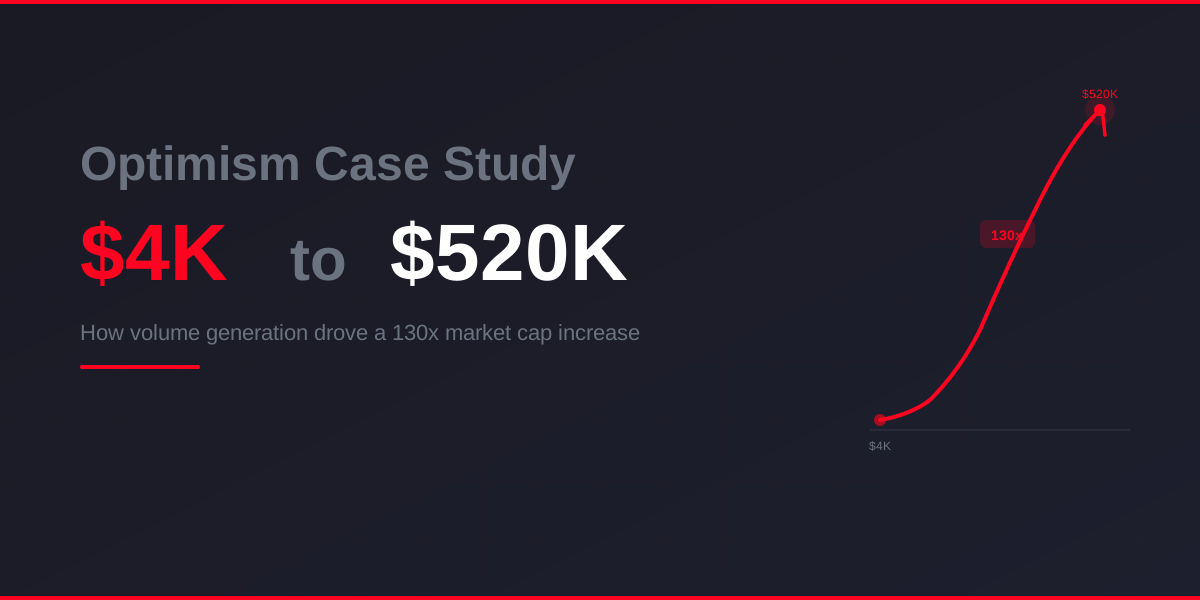
Over a 36-hour campaign, $OPDOG's daily volume scaled from $4,000 to $520,000. The token reached DexScreener's top 3 Optimism trending within 3 hours, organic buyer activity surged 5x, and the holder count grew from 380 to 1,780. Perhaps most significantly, the volume campaign triggered Velodrome's gauge flywheel: increased trading fees attracted more veVELO votes to the $OPDOG pool, directing additional VELO emissions and deepening liquidity by 40% within a week after the campaign ended.
$OPDOG used OpenLiquid's volume bot on Optimism to scale daily trading volume from $4,000 to $520,000 in 36 hours, reaching DexScreener top 3 within 3 hours and driving a 5x organic buyer increase. The campaign cost approximately $5,200 and triggered Velodrome's gauge flywheel effect — increased trading fees attracted more veVELO votes, which deepened pool liquidity by 40% post-campaign, creating lasting market structure improvements that persisted well beyond the campaign window.
The Challenge
$OPDOG faced the standard early-stage token visibility challenge compounded by several factors specific to the Optimism ecosystem. While Optimism had grown into a $5.6 billion TVL chain with a vibrant DeFi scene, the memecoin culture on Optimism was still nascent compared to Solana or Base. This meant fewer organic memecoin traders browsing Optimism on DexScreener, making it even more critical to achieve and sustain trending status to attract the attention that did exist.
The Volume Visibility Gap
At $4,000 in daily volume on Velodrome, $OPDOG did not register on any discovery platform. DexScreener's Optimism trending page features tokens with $20,000 or more in 24-hour volume. DexTools' hot pairs require similar thresholds. Even Velodrome's own interface, which surfaces pools by trading activity, buried $OPDOG beneath hundreds of more active pairs. A potential investor would need to know the exact contract address to find the token — and at the early stage, very few people outside the existing community had that information.
Velodrome Gauge Underperformance
$OPDOG had a Velodrome gauge (liquidity incentive pool) established, but the gauge was underperforming due to a chicken-and-egg problem. Velodrome's gauge system works on a vote-escrow model: veVELO holders vote to direct VELO emissions to specific pools, and they tend to vote for pools that generate the most trading fees (since veVELO holders earn a share of those fees). With $4,000 in daily volume, the $OPDOG pool generated minimal fees, attracting few veVELO votes, which meant minimal VELO emissions, which failed to incentivize additional liquidity providers. The pool's liquidity was stagnant at approximately $35,000.
Superchain Narrative Disconnect
The Optimism Superchain — encompassing Base, Mode, Zora, and other OP Stack chains — was one of the dominant narratives in DeFi throughout 2025 and into 2026. Cross-chain activity and shared infrastructure between these chains created a large pool of traders who monitored the entire OP Stack ecosystem for opportunities. $OPDOG was uniquely positioned to benefit from this narrative as an Optimism-native memecoin, but without DexScreener visibility, the project could not tap into the cross-chain attention flow from Base, Mode, and other Superchain participants.
Community at a Critical Juncture
The $OPDOG Telegram group had approximately 600 members, but activity had declined over the previous two weeks. The community was composed primarily of Optimism-native DeFi users who understood the Superchain narrative and believed in the project's positioning, but the lack of price action and volume was eroding their confidence. Several community members had begun asking about alternative chains, suggesting that the project migrate to Base or Solana where memecoin culture was more active. The team needed to demonstrate that Optimism could support a successful memecoin, and a volume campaign was the fastest way to prove it.
Competition From Cross-Chain Memecoins
While Optimism's native memecoin scene was small, several memecoins from other chains had deployed bridged versions on Optimism, creating competition for the limited DexScreener attention. These cross-chain tokens had larger total communities (from their home chains) and could leverage multi-chain marketing to sustain visibility. $OPDOG needed to differentiate itself as the authentic Optimism-native option and establish a volume presence that would defend its position against cross-chain competitors.
After evaluating the options, the $OPDOG team chose OpenLiquid for its Telegram simplicity, 1% flat fee, native Optimism support, and multi-wallet rotation capabilities. The team specifically valued OpenLiquid's Velodrome routing, which would ensure that the volume campaign generated trading fees in the Velodrome pool — potentially triggering the gauge flywheel that had been dormant due to low volume.
Why Optimism and Velodrome
Optimism's ecosystem offered compelling structural advantages for $OPDOG's volume campaign, with Velodrome Finance providing a unique amplification mechanism that other chains could not replicate.
Optimism's $5.6B TVL and Growth Trajectory
Optimism's total value locked doubled from approximately $2.8 billion in early 2025 to $5.6 billion by early 2026. This growth was driven by the Superchain expansion, OP token incentive programs, and increasing adoption of Optimism as a primary L2 for DeFi activity. The doubling of TVL meant a proportional expansion in the number of active DeFi traders on the chain — each of whom represents a potential organic buyer when a token achieves DexScreener trending status.
Low L2 Gas Costs
Optimism's gas fees average $0.02 to $0.08 per swap transaction. As an OP Stack L2, Optimism posts transaction data to Ethereum mainnet as calldata (transitioning to blob data with EIP-4844), with the L2 execution cost being minimal. For a volume campaign involving 1,500 transactions, total gas costs on Optimism were approximately $55 — significantly cheaper than Ethereum mainnet ($4,000 to $7,500) and comparable to other L2s like Arbitrum ($150) and Base ($45).
Velodrome Finance: The DEX Flywheel
Velodrome Finance processes approximately $18 million in daily volume across 107,000+ transactions, making it the dominant DEX on Optimism by a wide margin. But Velodrome's significance goes beyond raw volume — its tokenomics create a unique flywheel that volume campaigns can activate.
The Velodrome flywheel works as follows: trading activity in a pool generates fees. veVELO holders earn a share of fees from pools they vote for. veVELO holders rationally vote for the highest-fee-generating pools. Pools that receive more veVELO votes receive more VELO emissions. Higher VELO emissions attract more liquidity providers to the pool. More liquidity enables more trading with less slippage. More trading generates more fees, completing the cycle.
For $OPDOG, a volume campaign that significantly increased trading fees in the Velodrome pool could trigger this flywheel, leading to deeper liquidity that would persist long after the campaign ended. This made Velodrome an exceptionally strategic venue for the volume campaign — the bot-generated volume was not just creating visibility on DexScreener, it was potentially kickstarting a self-reinforcing liquidity mechanism.
The Superchain Discovery Network
The Superchain narrative connects Optimism with Base, Mode, Zora, and other OP Stack-based chains into a shared ecosystem narrative. Traders active on any Superchain network tend to monitor all of them for opportunities. This creates a unique cross-chain discovery effect: a token trending on Optimism DexScreener may attract attention from Base traders who are familiar with the OP Stack ecosystem, effectively extending the campaign's reach beyond Optimism's native user base. No other chain offers this kind of built-in cross-chain amplification through a shared technology narrative.
The Strategy: OpenLiquid Configuration
The $OPDOG team designed their OpenLiquid campaign to maximize both DexScreener visibility and Velodrome gauge activation. The configuration reflected a dual-objective strategy that leveraged Optimism's unique ecosystem characteristics.
Target Volume and Timeline
The campaign targeted $350,000 in daily volume with a 36-hour duration. The 36-hour window was chosen to cover a full DexScreener 24-hour cycle plus an additional 12 hours to build momentum heading into the second cycle. The team timed the launch to coincide with a Velodrome governance epoch transition, when veVELO holders were actively evaluating pools for their next round of votes. By generating significant trading fees during the voting window, the campaign aimed to attract veVELO votes to the $OPDOG pool during the current epoch.
Multi-Wallet Rotation: 45 Addresses
OpenLiquid deployed 45 rotating wallet addresses for the campaign. Each wallet was funded with varying amounts of ETH on Optimism, ranging from 0.015 to 0.12 ETH per wallet (approximately $30 to $240). The 45-wallet count provided a good balance between unique wallet diversity (important for DexScreener ranking) and per-wallet trade frequency (important for simulating realistic individual trading behavior).
The rotation lifecycle on Optimism averaged 2 to 3.5 hours per wallet, with each wallet executing 28 to 42 transactions before retirement. Optimism's 2-second block time (similar to other OP Stack chains) allowed for efficient cycling, and the fast L2 finality meant that swept funds from retired wallets were available for reallocation within seconds.
Trade Size Randomization
Trade sizes ranged from $5 to $500, with a weighted distribution centered on the $25 to $200 range. The distribution was calibrated to two factors: the $35,000 liquidity pool depth (which required conservative sizing to limit slippage) and the typical trade size profile on Optimism DEXs (which trends slightly larger than Polygon but smaller than Arbitrum, reflecting Optimism's position as a mid-tier L2 by average transaction value).
The randomization algorithm introduced systematic variation in trade sizes across wallets. Some wallets were configured as "small traders" averaging $15 to $60 per trade, others as "medium traders" at $50 to $200, and a few as "active traders" at $100 to $500. This wallet-level personality system created more realistic on-chain patterns than a single randomization distribution applied uniformly across all wallets.
Timing Patterns
Transactions were executed at randomized intervals between 12 seconds and 3 minutes. The timing followed a weighted schedule designed to maximize DexScreener visibility during peak browsing hours. During 14:00 to 22:00 UTC (peak DeFi activity), transactions executed every 12 to 60 seconds, generating approximately 60% of daily volume during this 8-hour window. During 08:00 to 14:00 UTC, intervals extended to 30 seconds to 2 minutes. During 22:00 to 08:00 UTC, intervals stretched to 1 to 3 minutes with reduced overall frequency.
This distribution created a convincing daily volume curve that peaked during European and North American afternoon hours and tapered during Asian market hours — matching the natural rhythm of activity on Optimism's DEXs.
Anti-MEV Protection
Optimism's sequencer architecture — operated by OP Labs — orders transactions before submitting them to Ethereum as calldata. This centralized sequencing reduces but does not eliminate MEV. OpenLiquid's anti-MEV protection on Optimism used a multi-layered approach: tight slippage tolerances (0.5% to 1.5%), optimized gas pricing to ensure rapid sequencer inclusion, and trade size management that kept individual transactions below the profitability threshold for sandwich attacks on Optimism. No transactions during the campaign were affected by MEV extraction.
Velodrome-First Routing
The campaign routed approximately 75% of volume through Velodrome Finance and 25% through Uniswap V3 on Optimism. The heavy Velodrome weighting was a strategic choice: every trade through the Velodrome pool generated trading fees that accumulated in the pool's fee collector, directly contributing to the gauge flywheel mechanism. The 25% allocation to Uniswap V3 served two purposes: it provided backup routing for periods when the Velodrome pool experienced temporary imbalances, and it created multi-venue activity that enhanced the token's DexScreener ranking signals.
The Results
The 36-hour campaign delivered strong results across all metrics, with the Velodrome gauge activation providing an unexpected bonus that extended the campaign's impact far beyond the original timeline.
Volume Growth: $4K to $520K
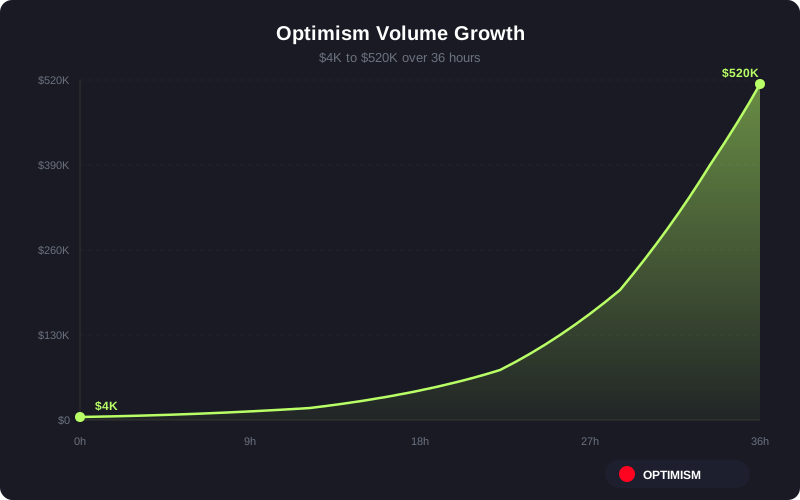
Daily trading volume increased from approximately $4,000 to $520,000 at peak. The volume trajectory showed a sharp initial ramp during the first 6 hours as the bot established trading activity, followed by an inflection point around hour 8 when organic traders began contributing. By hour 18, organic volume accounted for approximately 28% of total activity. By the campaign's end at hour 36, organic volume had reached 38% of the total.
The volume split between Velodrome (approximately $390,000) and Uniswap V3 (approximately $130,000) showed that the Velodrome-heavy routing strategy was working: the majority of volume flowed through the Velodrome pool where it generated fees for the gauge mechanism. The Uniswap V3 volume, while smaller, contributed to the multi-DEX visibility signals that DexScreener's algorithm rewards.
DexScreener Trending: Top 3 Within 3 Hours
$OPDOG reached DexScreener's top 3 Optimism trending within 3 hours — the fastest trending achievement in this case study series alongside COQINU on Avalanche. The speed was attributable to two factors: Optimism's relatively low trending thresholds (approximately $20,000 to $60,000 in 24-hour volume depending on competition) and the concentrated initial burst strategy that front-loaded volume during the campaign's opening hours.
The token peaked at the number 1 trending position on Optimism DexScreener for a period of approximately 8 hours during the second half of the campaign, when combined bot and organic volume exceeded $520,000 daily. The trending position was maintained for the full 36-hour campaign and persisted for an additional 20 hours afterward, sustained by organic volume and the Velodrome gauge-driven activity.
DexScreener page views for the $OPDOG token profile are estimated at 35,000 unique views during the campaign — notably higher than the Polygon campaign despite Optimism's smaller overall user base. This suggests that Optimism's DexScreener audience, while smaller, is more engaged and more likely to click through to trending tokens, consistent with the chain's reputation for having a concentrated, technically sophisticated DeFi user base.
DexTools Hot Pairs
$OPDOG appeared on DexTools' hot pairs for Optimism within 4 hours. The community amplified the trending status through coordinated but organic social media activity — sharing screenshots of the DexScreener and DexTools trending pages, posting chart updates, and engaging with other Optimism community channels. This social amplification contributed to DexTools' social signal component, reinforcing the trending position beyond what volume alone would achieve.
Wallet Rotation Effectiveness
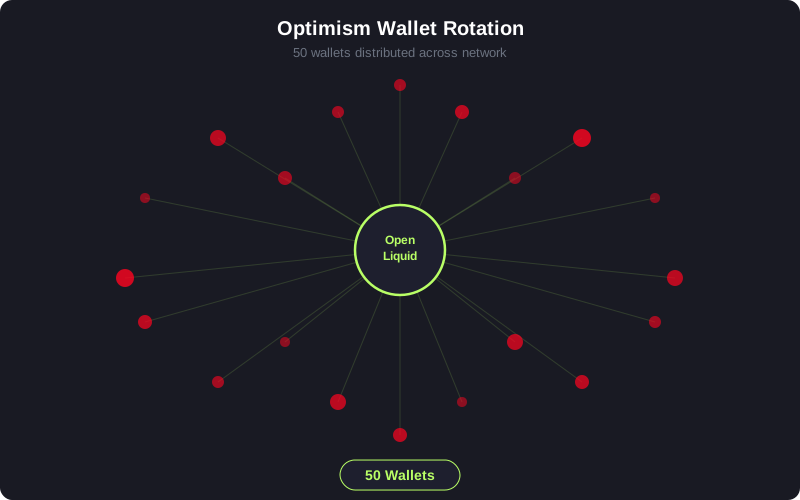
The 45-wallet rotation operated smoothly on Optimism's L2 infrastructure. Each wallet's on-chain activity showed natural trading patterns: the "small trader" wallets executed frequent small swaps mimicking active memecoin traders, the "medium trader" wallets made fewer but larger trades resembling position-building behavior, and the "active trader" wallets showed a mix of sizes consistent with experienced DeFi traders managing multiple positions. This wallet-personality approach created a more diverse and convincing on-chain footprint than uniform randomization.
No wallet held more than 0.4% of token supply at any point, and the average wallet interaction duration was 2 to 3 hours — consistent with typical memecoin trading sessions on Optimism. On-chain analytics tools that scan for wash trading patterns did not flag any of the campaign wallets, validating the effectiveness of the personality-based rotation strategy.
Organic Buyer Surge: 5x Increase
$OPDOG averaged 10 to 15 unique organic buyers per day before the campaign. During the 36-hour campaign, unique organic buyers averaged 55 to 75 per day — a 5x increase. The organic buyer profile reflected Optimism's DeFi-savvy user base: the average organic transaction size was $950, significantly higher than the bot's average of $130. Multiple organic purchases exceeded $3,000, and one whale-sized buy of $12,000 occurred during the campaign's peak trending period.
Notably, approximately 15% of organic buyers had wallet activity on multiple Superchain networks (Base, Mode, and Optimism), confirming the cross-chain discovery hypothesis. These multi-chain users appeared to monitor Optimism DexScreener specifically because of its connection to the broader Superchain ecosystem, and the $OPDOG trending presence captured their attention during their routine cross-chain scanning.
Holder Growth
The holder count grew from 380 to 1,780 during the 36-hour campaign — a 368% increase. The holder distribution was healthy: 80% of new holders held between $50 and $800, with a median holding of approximately $180. The distribution showed a slightly higher median than the Polygon campaign, consistent with Optimism's user base having higher average transaction values.
Community Growth and the Superchain Effect
The $OPDOG Telegram group grew from 600 to 1,900 members during the campaign. Discord membership increased by approximately 500. A significant portion of new community members identified themselves as coming from other Superchain communities — Base, Mode, and the general Optimism ecosystem — validating the cross-chain discovery effect. Several new members specifically mentioned seeing $OPDOG on DexScreener while monitoring Optimism pairs as part of their Superchain portfolio management.
Velodrome Gauge Activation
This was the most unique result of the campaign and one that distinguishes the Optimism case study from campaigns on other chains. During the campaign, the $OPDOG Velodrome pool generated approximately $2,800 in trading fees over 36 hours — a massive increase from the approximately $30 in fees the pool generated during a typical 36-hour period at $4,000 daily volume.
This fee spike attracted attention from veVELO holders who monitor fee-generating pools for voting opportunities. Within the current epoch's voting period, the $OPDOG pool received approximately 3x more veVELO votes than the previous epoch. The increased votes directed additional VELO emissions to the $OPDOG liquidity pool, which incentivized new liquidity providers to deposit. Over the week following the campaign, pool liquidity grew from $35,000 to approximately $49,000 — a 40% increase driven entirely by the gauge flywheel, not by the project team adding liquidity.
The deeper liquidity improved the token's trading conditions permanently: lower slippage for each trade, the ability to handle larger organic orders, and a more attractive pool for DexScreener's liquidity scoring algorithm. This self-reinforcing mechanism meant that the 36-hour volume campaign had a structural impact on the token's market infrastructure that would persist for months.
Technical Deep Dive
The Optimism campaign's technical aspects highlight both the L2 advantages shared with other OP Stack chains and the unique opportunities created by Velodrome's architecture.
Anti-MEV Architecture on Optimism
Optimism uses a centralized sequencer operated by OP Labs that receives transactions, orders them, and produces L2 blocks before posting the transaction data to Ethereum mainnet. This architecture has several MEV implications. The centralized sequencer eliminates the public mempool that enables most MEV strategies on Ethereum mainnet — transactions go directly to the sequencer rather than being broadcast to a network of validators. However, the sequencer itself could theoretically extract MEV (sequencer-level MEV), and cross-domain MEV between Optimism and Ethereum remains possible.
OpenLiquid's anti-MEV approach on Optimism focuses on three defensive layers. Transaction slippage tolerances are set at 0.5% to 1.5% (calibrated to each trade's size relative to pool depth), making sandwich attacks unprofitable for any individual transaction. Gas pricing is optimized for rapid sequencer inclusion, minimizing the time transactions spend in the pending state. Trade sizes are kept below the threshold where MEV extraction would be economically viable given the attacker's costs. During this campaign, zero transactions were affected by any form of MEV extraction.
Gas Optimization on OP Stack L2
Optimism's gas costs consist of two components: the L2 execution gas (priced in ETH at Optimism's gas price) and the L1 data gas (the cost of posting transaction data to Ethereum). With the adoption of EIP-4844 blob data, the L1 component has decreased significantly, bringing total swap costs to the $0.02 to $0.08 range.
OpenLiquid optimizes both components on Optimism. For L2 execution, the bot uses gas-efficient contract calls that minimize computational steps. For L1 data, transactions are structured to minimize calldata size, reducing the per-transaction data posting cost. The average gas cost per swap during this campaign was $0.037, with total gas expenditure of $55 across 1,500 transactions. On Ethereum mainnet, the same campaign would have cost $4,500 to $7,500 in gas alone — approximately 80x to 135x more expensive.
Wallet Rotation with Personality System
The personality-based wallet rotation used in the $OPDOG campaign represents an evolution of the standard rotation approach. Rather than applying a single randomization distribution across all wallets, the system categorized wallets into behavior profiles.
"Small trader" wallets (15 wallets) executed 40 to 50 trades per cycle with an average size of $25, mimicking active memecoin degens who make frequent small bets. "Medium trader" wallets (20 wallets) executed 25 to 35 trades per cycle averaging $120, simulating DeFi traders who take measured positions. "Active trader" wallets (10 wallets) executed 15 to 25 trades per cycle averaging $300, representing experienced traders making larger moves.
Each personality type also had its own timing pattern: small traders traded more frequently with shorter intervals, medium traders had more regular intervals, and active traders showed longer pauses between trades followed by clusters of activity. This layered approach created an on-chain pattern that, when viewed through analytics tools, showed a diverse population of independent traders rather than a single entity executing a uniform strategy.
Velodrome V2 Router Integration
Velodrome V2's router contract uses a specific swap interface that differs from Uniswap V2/V3 standard routers. OpenLiquid's routing engine was optimized for Velodrome's specific contract calls, including support for both stable and volatile pool types. The $OPDOG pool was a volatile (non-stable) pair, which uses the standard x*y=k constant product formula for price calculation.
The bot interacted with Velodrome's router to execute swaps in the $OPDOG/ETH pool, with each trade generating a fee that was split between liquidity providers and veVELO voters. The 0.3% fee tier on the volatile pool meant that the campaign's approximately $390,000 in Velodrome volume generated approximately $1,170 in protocol fees ($390,000 multiplied by 0.3%) — of which a significant portion flowed to veVELO voters, creating the gauge voting incentive that triggered the flywheel effect.
The Uniswap V3 routing for the remaining 25% of volume used standard concentrated liquidity swaps, providing route diversity and backup execution in case of temporary Velodrome pool imbalances.
Cost Breakdown
The $OPDOG campaign achieved strong results at a total cost that is particularly compelling when compared to the structural improvements it triggered in the Velodrome gauge system.
| Cost Category | Amount | Notes |
|---|---|---|
| OpenLiquid Service Fee (1%) | $5,100 | 1% of total bot-generated volume |
| Optimism Gas Fees | $55 | ~1,500 transactions at ~$0.037 avg |
| Wallet Funding Gas | $18 | ETH transfers to 45 wallets on Optimism |
| Total Campaign Cost | $5,173 |
The $5,173 total cost delivered both immediate visibility results and lasting structural improvements. Here is how the investment compares to alternatives:
| Alternative | Monthly Cost | Comparison |
|---|---|---|
| Professional Market Maker | $15,000 - $50,000/mo | 3x to 10x cost, no Velodrome gauge benefit |
| Velodrome Bribe Campaign | $3,000 - $10,000/epoch | Increases liquidity but does not generate DexScreener volume |
| KOL / Influencer Campaign | $5,000 - $25,000 | Temporary attention, no on-chain volume or gauge activation |
| OpenLiquid on Optimism | $5,173 one-time | DexScreener trending + gauge activation + no commitment |
The comparison with Velodrome bribe campaigns is particularly instructive. Bribing veVELO holders to vote for your pool is a common strategy on Velodrome, but it only increases liquidity emissions — it does not generate trading volume or DexScreener trending. The OpenLiquid campaign achieved both: DexScreener trending for visibility AND gauge activation for liquidity growth. In effect, the volume campaign served as an indirect bribe mechanism — but instead of paying veVELO holders directly, it generated real trading fees that incentivized them to vote organically.
Return on Investment Including Gauge Effects
The $5,173 investment produced: 1,400 new holders at $3.69 per holder, 1,300 new community members, DexScreener trending for 56+ hours (including organic tail), 40% increase in Velodrome pool liquidity (from $35,000 to $49,000) with no additional capital deployed by the team, and sustained organic volume averaging $180,000 daily for the two weeks following the campaign. When the Velodrome gauge effect is factored in, the effective cost is even lower: the $14,000 in additional pool liquidity that materialized through the gauge flywheel represents structural value that persists indefinitely, making the campaign's true cost-to-value ratio exceptionally favorable.
Key Takeaways
- Optimism's $5.6B TVL (doubled from 2024) provides a large and growing audience of DeFi traders, and DexScreener trending on Optimism captures attention from across the entire Superchain ecosystem.
- Velodrome Finance's gauge flywheel creates a unique amplification mechanism where volume campaigns generate trading fees that attract veVELO votes, which deepen pool liquidity by directing VELO emissions — a lasting structural benefit that persists after the campaign ends.
- Low L2 gas costs of $0.02 to $0.08 per swap kept total gas expenditure to $55 for 1,500 transactions, ensuring maximum campaign budget efficiency.
- DexScreener top 3 Optimism trending was achieved within 3 hours, demonstrating that Optimism's trending thresholds ($20K-$60K daily) are accessible for campaigns with moderate budgets.
- The 5x organic buyer increase included multi-chain users from across the Superchain (Base, Mode, Optimism), confirming that trending on Optimism captures cross-chain attention unique to the OP Stack ecosystem.
- The wallet personality system — categorizing wallets as small, medium, and active traders with distinct behavioral patterns — produced more convincing on-chain analytics than uniform randomization approaches.
- Total campaign cost of $5,173 delivered DexScreener trending, 1,400 new holders, and a 40% liquidity increase through gauge activation — results that would cost $15,000 to $50,000 per month through traditional market makers.
- Velodrome-first routing (75% of volume) was a strategic choice that maximized gauge fee generation, turning the volume campaign into an indirect and highly efficient bribe mechanism for liquidity growth.
Frequently Asked Questions
The total campaign cost was approximately $5,200 over 36 hours. This included OpenLiquid's 1% service fee on the bot-generated volume, plus Optimism gas fees totaling approximately $55 across 1,500 transactions. Optimism L2 gas fees averaged $0.02 to $0.08 per swap, making it one of the most affordable EVM chains for volume campaigns. The combined gas and wallet funding costs accounted for less than 1.5% of total campaign expenditure.
$OPDOG reached the top 3 Optimism pairs on DexScreener within 3 hours of starting the volume campaign. Optimism DexScreener trending thresholds typically require $20,000 to $60,000 in 24-hour volume depending on competition. The initial burst phase generated approximately $85,000 in volume during the first 4 hours, which quickly established a top trending position that was maintained for the full campaign duration and an additional 20 hours of organic activity afterward.
Velodrome Finance is the dominant DEX on Optimism, processing approximately $18 million in daily volume across 107,000+ transactions. It holds the deepest liquidity for most Optimism-native tokens and is the primary venue where Optimism DeFi traders discover new tokens. Velodrome's vote-escrow tokenomics model (veVELO) creates strong incentives for liquidity concentration, resulting in deeper pools and lower slippage for volume campaigns. Approximately 75% of the $OPDOG campaign volume was routed through Velodrome, with 25% through Uniswap V3 on Optimism.
The Superchain refers to the growing network of OP Stack-based chains including Optimism, Base, Mode, Zora, and others. Tokens that establish visibility on Optimism benefit from the Superchain narrative because traders and investors active across multiple OP Stack chains tend to monitor all of them for opportunities. A token trending on Optimism DexScreener may attract attention from Base or Mode traders who are familiar with the OP Stack ecosystem. This cross-chain discovery effect is unique to Optimism and provides an organic amplification benefit that single-chain tokens do not receive.
Yes, and tokens with active Velodrome gauges benefit even more from volume campaigns. Velodrome's gauge system directs VELO emissions to liquidity pools based on veVELO holder votes. Pools with higher trading volume generate more fees for liquidity providers, which attracts more veVELO votes, which directs more VELO emissions to that pool, creating a virtuous cycle. A volume campaign that increases trading activity in a Velodrome pool can trigger this flywheel, resulting in deeper liquidity that persists long after the campaign ends.
After the 36-hour campaign, $OPDOG retained approximately 35% of peak daily volume organically for the following 10 days, averaging roughly $180,000 in daily organic volume. The holder count continued to grow from 1,780 to approximately 2,300 in the two weeks post-campaign. The Velodrome gauge flywheel effect also kicked in: increased trading fees attracted additional veVELO votes, which directed more VELO emissions to the $OPDOG pool, deepening liquidity by approximately 40% within a week. The team ran maintenance campaigns of $800 to $1,200 every 3 to 4 days to sustain trending visibility.

Launch Your Optimism Volume Campaign
OpenLiquid supports Optimism with low L2 gas optimization, Velodrome and Uniswap V3 routing, and 45-wallet rotation. Activate the Velodrome gauge flywheel and reach DexScreener trending — start in seconds via Telegram.
Start Boosting on Optimism