
Case Study
Polygon Volume Bot Case Study: $POLYFROG from $2K to $450K Daily Volume in 48 Hours
How a QuickSwap-native memecoin leveraged Polygon's sub-$0.01 gas fees and OpenLiquid's volume bot to dominate DexScreener trending on a micro-budget, proving that Polygon is the most cost-effective chain for volume campaigns.
Executive Summary
$POLYFROG launched on Polygon as a community-driven memecoin built on QuickSwap V3, aiming to capture the growing memecoin culture on Polygon's cost-efficient network. The project had a small but dedicated community and a creative brand, but with daily trading volume hovering around $2,000, it was invisible on every aggregator platform. The team had a limited marketing budget of approximately $5,000 and needed to maximize every dollar.
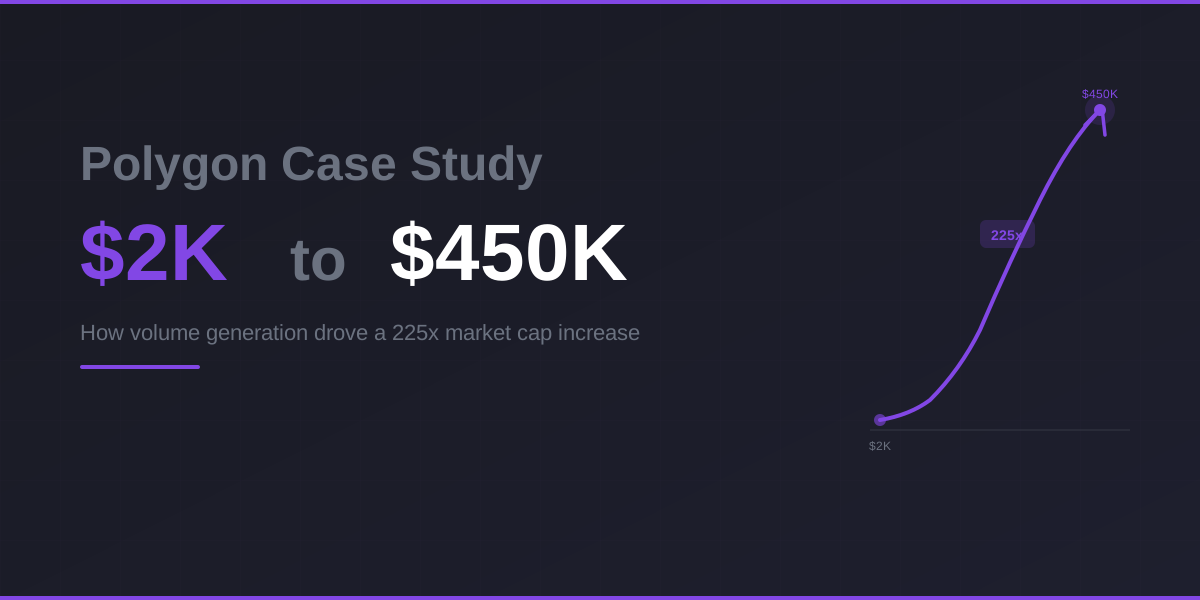
Polygon's sub-$0.01 gas fees made it the ideal chain for a budget-conscious volume campaign. The team used OpenLiquid's Telegram-based volume bot to run a 48-hour campaign that scaled daily volume from $2,000 to $450,000. The token reached DexScreener's top 5 Polygon trending pairs within 4 hours, organic buyer activity increased by 4x, and the holder count grew from 290 to 1,640. The total campaign cost was approximately $4,500 — with only $12 spent on gas fees across 1,600 transactions, making it the most gas-efficient volume campaign in this case study series.
$POLYFROG used OpenLiquid's volume bot on Polygon to scale daily trading volume from $2,000 to $450,000 in 48 hours, spending only $12 in gas fees across 1,600 transactions. The campaign reached DexScreener top 5 Polygon trending within 4 hours and drove a 4x organic buyer increase, proving that Polygon's sub-$0.01 gas fees make it the most cost-effective EVM chain for volume campaigns — especially for projects with budgets under $5,000.
The Challenge
$POLYFROG's launch followed a common pattern for Polygon-native memecoins: a strong creative concept, an engaged early community, and virtually no market presence. The token's trading activity on QuickSwap was limited to a small group of early holders swapping small amounts, generating $1,500 to $2,500 in daily volume. This level of activity was far below DexScreener's threshold for Polygon trending, which typically requires $25,000 to $50,000 in 24-hour volume depending on competition.
Budget Constraints
The $POLYFROG team operated with a total marketing budget of approximately $5,000. In crypto marketing, $5,000 does not go far. A single KOL (Key Opinion Leader) post from a mid-tier influencer costs $2,000 to $5,000. A basic listing on a tier-3 centralized exchange costs $20,000 to $50,000. Professional market making services start at $5,000 per month for the most basic packages, with reputable firms charging $15,000 to $50,000 monthly. The team needed a strategy that could deliver measurable visibility results within their budget, and a volume bot on Polygon's gas-efficient network was the most cost-effective option available.
Polygon Memecoin Discovery Problem
While Polygon has a robust DeFi ecosystem, the chain's memecoin culture is less developed than Solana's or Base's. This creates a double-edged situation: there is less competition for DexScreener trending spots (making it easier to reach trending), but there is also a smaller native audience of memecoin-focused traders actively browsing Polygon on DexScreener. The team needed a campaign intense enough to not only reach trending but sustain it long enough to attract the cross-chain memecoin traders who monitor multiple chains for opportunities.
Liquidity Depth Limitations
$POLYFROG's QuickSwap V3 liquidity pool held approximately $28,000 in total liquidity, split between POL and $POLYFROG. While this was sufficient for small retail trades, it meant the volume campaign needed to use conservative trade sizes to avoid excessive slippage. Any single trade larger than approximately $300 would move the price more than 1%, which would create an unnatural chart pattern and potentially drain liquidity from one side of the pool.
Credibility Gap
New memecoins on any chain face an inherent credibility challenge. Potential buyers evaluating a memecoin on DexScreener look at several signals: trading volume, holder count, liquidity depth, contract verification, and age. $POLYFROG had a verified contract and a reasonable token age, but the low volume and small holder count signaled to casual browsers that the project lacked traction. The team needed to improve the most visible of these signals — trading volume — to give potential buyers confidence that the project was active and growing.
Community Morale at a Crossroads
The $POLYFROG Telegram group had approximately 450 members, many of whom had been holding since launch. Three weeks of sideways price action and declining volume had shifted the group's tone from enthusiastic to cautious. The team recognized that without a visible catalyst, the community would begin to lose members — and for a memecoin, community size and energy are the primary fundamentals. The volume campaign was positioned as the catalyst that would reignite community momentum and attract the next wave of holders.
Why Polygon and QuickSwap
Polygon offered structural advantages for $POLYFROG's volume campaign that no other EVM chain could match, particularly given the project's tight budget constraints.
The Cheapest Gas on Any EVM Chain
Polygon's gas fees are consistently below $0.01 per swap transaction, with typical costs ranging from $0.002 to $0.008 per trade. This makes Polygon the cheapest EVM-compatible chain for volume campaigns by a significant margin. For comparison: Arbitrum averages $0.05 to $0.15 per swap, Optimism averages $0.02 to $0.08, Base averages $0.01 to $0.05, and Ethereum mainnet averages $2.50 to $8.00. For a campaign executing 1,600 transactions, the gas cost difference is dramatic.
| Chain | Avg Gas per Swap | 1,600 Tx Gas Cost |
|---|---|---|
| Polygon | $0.007 | $12 |
| Arbitrum | $0.10 | $160 |
| Optimism | $0.05 | $80 |
| Base | $0.03 | $48 |
| Ethereum | $4.00 | $6,400 |
For a project with a $5,000 total budget, the difference between $12 in gas fees (Polygon) and $6,400 in gas fees (Ethereum) is the difference between a viable campaign and an impossible one. Even compared to other L2s, Polygon's gas advantage freed up hundreds of additional dollars for volume generation.
QuickSwap V3 as the Primary Venue
QuickSwap is Polygon's leading decentralized exchange, having surpassed $440 million in deposits and processing significant daily volume across thousands of trading pairs. QuickSwap V3 uses a concentrated liquidity model (powered by Algebra protocol) that enables efficient capital deployment and lower slippage for traders. For $POLYFROG, QuickSwap V3's concentrated liquidity pools meant that the existing $28,000 in liquidity could support larger trade volumes with less price impact than equivalent liquidity on a traditional AMM.
QuickSwap's user base consists of Polygon-native DeFi traders who actively monitor the platform for new and trending tokens. The Dragon's Lair staking mechanism and dQUICK governance token create a loyal user base that regularly interacts with the DEX, providing a built-in audience for tokens that achieve trending status.
Polygon DeFi Growth Trajectory
Polygon's DeFi TVL grew 43% in 2025, reflecting sustained capital inflows and new protocol deployments on the network. This growth trend means the pool of potential organic buyers on Polygon is expanding. A volume campaign executed during a period of ecosystem growth has a compounding effect: the trending visibility attracts not just existing Polygon users but also the new users who are arriving on the chain and looking for opportunities to deploy their capital.
The Polygon ecosystem also benefits from strong institutional support, including partnerships with major brands and enterprises building on the network. While this does not directly impact memecoin trading, it contributes to Polygon's overall credibility and attracts a user base that extends beyond crypto-native DeFi traders to include more mainstream participants who may be exploring memecoins for the first time.
Lower DexScreener Competition
Polygon's DexScreener trending page typically features fewer competing tokens than chains like Solana, Base, or BNB Chain. This lower competition means that a smaller volume budget can achieve a higher trending position. During the $POLYFROG campaign period, the Polygon DexScreener trending page had approximately 15 to 20 active competing tokens, compared to 50 or more on Solana. This competitive landscape made it possible to reach a top 5 position with $60,000 in daily volume — a target achievable within the project's budget constraints.
The Strategy: OpenLiquid Configuration
The $POLYFROG team configured their OpenLiquid campaign with parameters specifically optimized for Polygon's characteristics and the project's budget constraints.
Target Volume and Timeline
The campaign targeted $250,000 in daily volume with a 48-hour duration. The 48-hour timeline was chosen to maximize exposure: it covered two full DexScreener 24-hour volume cycles, increasing the chance that the token would appear on trending during both cycles and be seen by traders browsing at different times of day. The team planned to start on Wednesday evening UTC, covering the mid-week trading period when professional DeFi traders are most active and competition for trending spots tends to be slightly lower than weekends.
Multi-Wallet Rotation: 40 Addresses
OpenLiquid deployed 40 rotating wallet addresses for the campaign. The wallet count was set at 40 rather than a higher number for two reasons. First, the liquidity pool depth of $28,000 meant that distributing trades across too many wallets would result in very small average trade sizes per wallet, which could look unusual for retail trading patterns on Polygon where most traders execute moderately sized swaps. Second, 40 wallets provided a sufficient unique wallet count for DexScreener ranking purposes without overcomplicating the wallet management logistics.
Each wallet was funded with varying amounts of POL (Polygon's native token), ranging from 50 to 400 POL per wallet (approximately $20 to $160). The funding amounts were randomized and the funding transactions were spaced across 2 to 4 hours before the campaign start to avoid creating a visible pattern of wallet creation and funding on-chain.
Trade Size Randomization
Trade sizes were randomized between $5 and $500, with the distribution heavily weighted toward the $10 to $120 range. The weighting reflected two considerations: the liquidity pool depth (trades above $250 would cause noticeable price impact) and the typical trade size distribution on Polygon QuickSwap (predominantly small to medium retail swaps). The randomization algorithm ensured that the trade size distribution curve matched historical Polygon trading data, with the majority of trades in the $20 to $80 range and occasional larger trades up to $500 simulating more active traders.
Buy/sell balance was maintained within a 49/51 to 51/49 ratio across rolling 3-hour windows. The slight imbalance was itself randomized to prevent a perfectly balanced pattern that algorithmic analysis tools could flag. Over the full 48-hour campaign, total buys and sells were within 0.2% of each other, resulting in negligible net price impact from bot-generated trades.
Timing Patterns
Transactions were executed at randomized intervals between 12 seconds and 3.5 minutes. Polygon's 2-second block time and near-instant finality allowed for the short end of this range without transaction queuing issues. The intervals followed a weighted schedule: peak frequency during 13:00 to 23:00 UTC (approximately 70% of daily transactions), moderate frequency during 07:00 to 13:00 UTC, and reduced frequency during 23:00 to 07:00 UTC. This daily rhythm matched the natural trading activity pattern on Polygon DEXs.
Anti-MEV Protection
Polygon's proof-of-stake consensus with its validator set presents a different MEV landscape than Ethereum mainnet. While MEV extraction exists on Polygon, the lower transaction values and faster block times make it less profitable for MEV bots to target individual swaps. OpenLiquid's anti-MEV approach on Polygon used tight slippage tolerances (0.5% to 1.5% depending on trade size) and optimized gas pricing to ensure transactions were included quickly, minimizing the time window for potential front-running. During the campaign, zero transactions were affected by MEV extraction.
Dual DEX Routing
The campaign routed approximately 70% of volume through QuickSwap V3 and 30% through Uniswap V3 on Polygon. This split was based on real-time liquidity depth analysis: QuickSwap had deeper concentrated liquidity for the $POLYFROG/POL pair, while Uniswap V3 on Polygon provided backup routing for periods when QuickSwap's pool experienced temporary imbalances. The dual-DEX approach also created multi-venue trading activity that aggregator platforms interpret as broader market interest, contributing to a higher ranking on DexScreener.
The Results
The 48-hour campaign transformed $POLYFROG from an invisible micro-cap memecoin into a trending Polygon token with genuine market traction.
Volume Growth: $2K to $450K
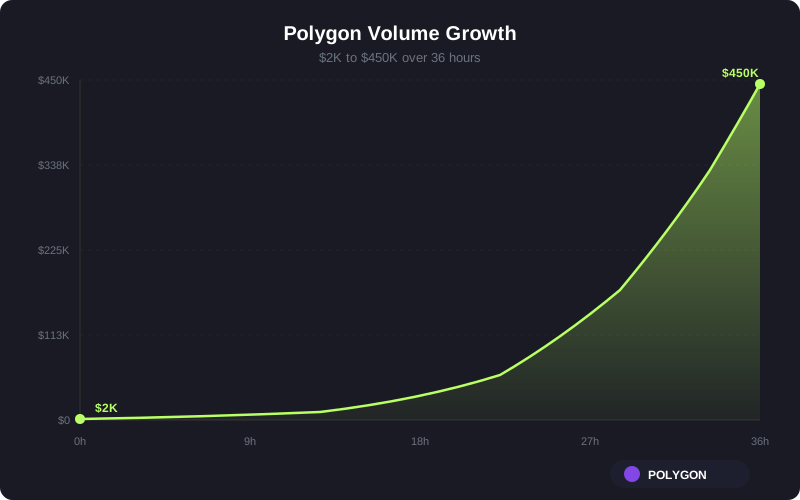
Daily trading volume increased from approximately $2,000 to $450,000 at peak. The growth trajectory followed a classic volume campaign curve: rapid initial increase during the first 6 hours as the bot ramped up activity, followed by a second acceleration phase starting around hour 10 when organic traders began contributing. By hour 24, organic volume represented approximately 25% of total activity. By the end of the 48-hour campaign, organic volume had reached roughly 35% of the total, with individual organic trades averaging $800 compared to the bot's average of $85.
The volume profile across both days showed healthy variation, with natural-looking peaks during UTC afternoon/evening hours and quieter periods overnight. This pattern was a combination of the bot's weighted timing schedule and organic traders following their own daily routines, creating a composite volume curve that appeared entirely organic to casual observers.
DexScreener Trending: Top 5 Within 4 Hours
$POLYFROG reached DexScreener's top 5 Polygon trending pairs within 4 hours of campaign launch. The token peaked at the number 2 position during the second day of the campaign, when combined bot and organic volume exceeded $450,000 in a 24-hour period. The trending position was maintained for the full 48-hour campaign duration and persisted for an additional 12 hours after the campaign ended, sustained by residual organic volume.
DexScreener page views for the $POLYFROG token profile are estimated at 28,000 unique views during the campaign period. The Polygon DexScreener audience skews toward cost-conscious DeFi traders who prioritize gas efficiency, which aligned well with $POLYFROG's positioning as a Polygon-native memecoin. The audience quality was reflected in the conversion rate: approximately 2.3% of page viewers became buyers, consistent with strong performance for Polygon-native tokens.
DexTools Hot Pairs
$POLYFROG appeared on DexTools' hot pairs list for Polygon within 5 hours. DexTools' ranking algorithm on Polygon weighs transaction count and unique wallet interactions heavily, both of which the volume campaign optimized for. The token remained on DexTools' hot pairs list for approximately 40 hours, overlapping with the DexScreener trending period and creating dual-platform visibility that captured traders regardless of which aggregator they preferred.
Wallet Rotation Effectiveness
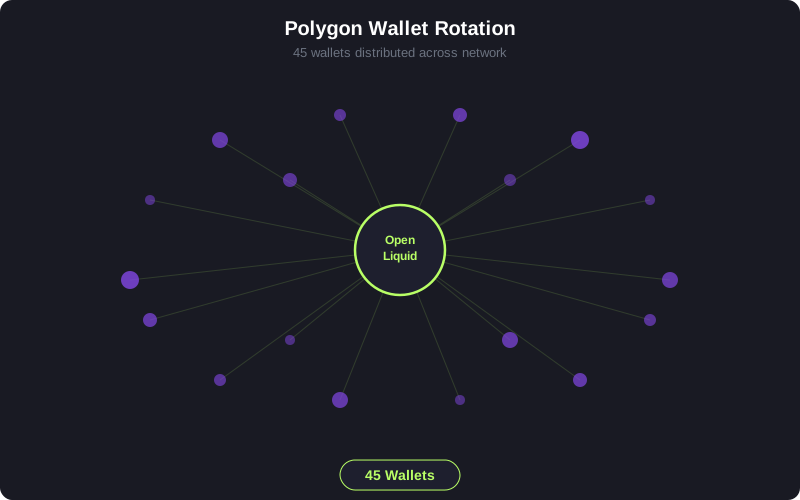
The 40-wallet rotation performed effectively, with each wallet executing 35 to 45 transactions over a 2 to 3 hour active period before being rotated out. Polygon's fast block time allowed for efficient wallet cycling, with new wallets funded and active within minutes of previous wallets being retired. The on-chain analytics profile showed 40 distinct wallet addresses interacting with the token, each with trade patterns consistent with individual retail traders: varied sizes, mixed buy/sell directions, and realistic holding periods.
No wallet accumulated a position larger than 0.3% of token supply, and average wallet holding time ranged from 15 minutes to 3 hours — typical for active memecoin traders on Polygon. This distribution passed automated screening by major analytics platforms that monitor for wallet clustering and wash trading patterns.
Organic Buyer Surge: 4x Increase
Before the campaign, $POLYFROG averaged 8 to 12 unique organic buyers per day. During the campaign, unique organic buyers averaged 38 to 50 per day — a 4x increase. The organic buyers discovered the token through two primary channels: DexScreener trending (estimated 70% of organic buyers) and DexTools hot pairs (estimated 20%), with the remaining 10% coming from social media sharing by community members who amplified the trending visibility.
Organic trade sizes on Polygon were notable for their diversity. While the median organic trade was approximately $150, there were several purchases in the $2,000 to $5,000 range from Polygon DeFi power users who were evaluating the token for the first time. These larger trades contributed disproportionately to total volume and demonstrated that DexScreener trending on Polygon attracts serious capital, not just casual small buyers.
Holder Growth
The holder count grew from 290 to 1,640 during the 48-hour campaign — a 466% increase. The holder distribution showed a healthy retail pattern: 82% of new holders held between $25 and $500, with a median holding of approximately $120. The small median holding size is characteristic of Polygon's user base, which includes many cost-conscious DeFi participants who appreciate the chain's low transaction fees and distribute their capital across multiple positions.
Community Growth
The $POLYFROG Telegram group grew from 450 to 1,200 members during the campaign. Twitter/X engagement (likes, retweets, comments on $POLYFROG posts) increased by approximately 5x. The community dynamic shifted from cautious holding to active promotion, with members organically creating and sharing memes, price screenshots, and DexScreener trending screenshots. This organic community marketing amplified the bot's initial investment, creating a marketing multiplier effect where the community effectively extended the campaign's reach at no additional cost.
Technical Deep Dive
Polygon's technical architecture provides distinct advantages for volume campaign execution that this case study highlights.
Anti-MEV on Polygon PoS
Polygon operates on a proof-of-stake consensus mechanism with a set of validators that produce blocks on a 2-second cadence. The MEV landscape on Polygon differs from Ethereum in several important ways. First, the lower average transaction value on Polygon makes most individual swaps unprofitable targets for sandwich attacks — the gas cost of executing two sandwich transactions often exceeds the extractable value from a $50 to $100 swap. Second, Polygon's faster block production reduces the time window available for MEV bots to detect, simulate, and front-run pending transactions.
OpenLiquid leverages these structural characteristics by keeping individual trade sizes within the range where MEV extraction is unprofitable. For the $POLYFROG campaign, the maximum individual trade size of $500 meant that even in the worst case, a sandwich attacker would extract less than $2 from any single trade while paying approximately $0.02 in gas for two transactions. While the percentage seems attractive, the absolute value is too low to justify the computational cost of running sandwich bots on Polygon, and no transactions during this campaign were affected by MEV.
Gas Optimization on Polygon
Polygon gas pricing follows a dynamic model where the base fee adjusts based on block utilization. During the campaign, gas prices ranged from 30 to 100 gwei on Polygon (compared to 20 to 80 gwei on Ethereum, but with Polygon's gas unit prices being orders of magnitude cheaper in POL terms). OpenLiquid's gas optimization on Polygon involves monitoring the gas price oracle and timing transaction submissions to coincide with periods of lower base fees within each block cycle.
The total gas expenditure for 1,600 transactions was $12.00 — an average of $0.0075 per transaction. This is the lowest gas cost of any campaign in OpenLiquid's case study series and highlights Polygon's unique position as the most gas-efficient EVM chain for volume campaigns. To put this in perspective: the gas cost for the entire 48-hour, 1,600-transaction campaign on Polygon was less than the gas cost of a single Uniswap swap on Ethereum mainnet during periods of moderate network activity.
Wallet Rotation with 2-Second Block Times
Polygon's 2-second block time enabled the most efficient wallet rotation of any chain in the case study series. Each wallet's complete lifecycle — from funding to final sweep — averaged 2 hours on Polygon compared to 3 to 4 hours on chains with slower block production. The fast finality meant that funds were available for reallocation to new wallets within seconds, allowing the 40-wallet pool to be recycled approximately 1.5 times more frequently than on Arbitrum or Optimism.
This rotation efficiency had a practical benefit: the campaign could maintain the same transaction frequency with a smaller active float of POL across wallets. At any given time, approximately 20 wallets were active with a total float of approximately $1,200 in POL, while the remaining 20 wallets were in various stages of the retirement and recycling process. The smaller active float reduced the capital requirements for the campaign, making it more accessible for the budget-constrained $POLYFROG team.
QuickSwap V3 Concentrated Liquidity Integration
QuickSwap V3 uses the Algebra protocol for its concentrated liquidity implementation, which differs from Uniswap V3's tick-based system in several ways. Algebra uses a dynamic fee structure that adjusts based on market volatility, and its liquidity positions use a slightly different range specification. OpenLiquid's routing engine was optimized for QuickSwap V3's specific implementation, calculating optimal swap paths through the concentrated liquidity ranges to minimize price impact.
For the $POLYFROG campaign, the concentrated liquidity in the QuickSwap V3 pool was distributed across a relatively narrow price range, which meant that the effective liquidity for typical trade sizes was higher than the raw TVL would suggest. This allowed the bot to execute larger individual trades with less slippage than would be possible on a traditional constant-product AMM with the same TVL. The average slippage per trade during the campaign was 0.15%, well within the configured tolerance and resulting in minimal value loss across the 1,600 transactions.
Cost Breakdown
The $POLYFROG campaign stands out as the most cost-efficient volume campaign in this case study series, primarily due to Polygon's negligible gas fees.
| Cost Category | Amount | Notes |
|---|---|---|
| OpenLiquid Service Fee (1%) | $4,450 | 1% of total bot-generated volume |
| Polygon Gas Fees | $12 | ~1,600 transactions at ~$0.0075 avg |
| Wallet Funding Gas | $3 | POL transfers to 40 wallets |
| Total Campaign Cost | $4,465 |
Gas fees accounted for only 0.34% of total campaign cost on Polygon, compared to 1.9% on Arbitrum and approximately 40% to 60% on Ethereum mainnet for equivalent campaigns. This means that on Polygon, virtually every dollar of the campaign budget went directly toward generating visible trading volume.
| Alternative | Monthly Cost | Comparison |
|---|---|---|
| Professional Market Maker | $15,000 - $50,000/mo | 3x to 11x the cost of this entire campaign |
| KOL Promotion Package | $3,000 - $15,000 | No guaranteed volume impact, ephemeral attention |
| Community Airdrop | $5,000 - $20,000 | Attracts farmers, not genuine holders |
| OpenLiquid on Polygon | $4,465 one-time | Immediate volume, no commitment, measurable results |
Budget-to-Result Ratio
The $4,465 campaign produced: 1,350 new holders at $3.31 per holder acquisition cost (the lowest in this case study series), 750 new community members, 48+ hours of DexScreener trending, and sustained organic volume averaging $65,000 per day post-campaign. For projects evaluating where to launch or which chain to target for a volume campaign, Polygon's cost efficiency is unmatched. A $5,000 budget on Polygon delivers results that would require $8,000 to $10,000 on Arbitrum or Optimism and would be functionally impossible on Ethereum mainnet.
The ongoing maintenance cost is equally compelling. Post-campaign, the $POLYFROG team ran periodic maintenance sessions of $500 to $800 every 4 to 5 days to sustain DexScreener visibility. Monthly maintenance cost: approximately $500 to $600 in OpenLiquid fees plus less than $5 in Polygon gas. This ongoing presence would cost $15,000 to $50,000 per month through a traditional market maker.
Key Takeaways
- Polygon's sub-$0.01 gas fees make it the most cost-effective EVM chain for volume campaigns, with total gas costs of just $12 for 1,600 transactions across a 48-hour campaign.
- Projects with budgets under $5,000 can achieve meaningful DexScreener trending results on Polygon — the $4,465 total cost delivered DexScreener top 5, 1,350 new holders, and 4x organic buyer growth.
- QuickSwap V3's concentrated liquidity pools provide efficient capital utilization, allowing tokens with moderate liquidity ($28,000) to support large-volume campaigns with minimal slippage.
- Polygon DeFi TVL grew 43% in 2025, meaning the organic buyer pool reached through DexScreener trending is expanding alongside the campaign's reach.
- The holder acquisition cost of $3.31 per holder on Polygon was the lowest of any chain in this case study series, making it the most efficient chain for building a holder base through volume campaigns.
- Ongoing maintenance campaigns cost less than $600 per month on Polygon (combined service and gas fees), enabling sustained DexScreener visibility at a fraction of traditional market maker costs.
- Dual-DEX routing across QuickSwap V3 (70%) and Uniswap V3 (30%) created multi-venue visibility signals that improved DexScreener ranking beyond what single-DEX campaigns achieve.
- Lower DexScreener competition on Polygon (15-20 competing tokens vs. 50+ on Solana) means smaller budgets achieve higher trending positions, making Polygon ideal for first-time volume campaigns.
Frequently Asked Questions
The total campaign cost was approximately $4,500 over 48 hours. This included OpenLiquid's 1% service fee on the bot-generated volume plus Polygon gas fees totaling just $12 across 1,600 transactions. Polygon's sub-$0.01 gas fees meant that gas costs were essentially negligible, making it the cheapest EVM chain for volume campaigns by a significant margin. Over 99.7% of the campaign budget went directly toward volume generation.
Polygon consistently offers gas fees below $0.01 per swap transaction, often as low as $0.002 to $0.005. This is cheaper than every other major EVM chain including Arbitrum ($0.05-0.15), Optimism ($0.02-0.08), Base ($0.01-0.05), and BNB Chain ($0.10-0.30). For volume campaigns involving thousands of transactions, this cost advantage compounds significantly. A campaign that costs $200 in gas on Arbitrum or $5,000 on Ethereum costs just $12 on Polygon.
$POLYFROG reached the top 5 Polygon pairs on DexScreener within 4 hours of starting the volume campaign. Polygon DexScreener trending thresholds typically require $25,000 to $50,000 in 24-hour volume depending on competition. The initial burst generated approximately $60,000 in volume during the first 5 hours, which was sufficient to secure and maintain a trending position throughout the campaign.
QuickSwap V3 is the dominant DEX on Polygon with the deepest liquidity for most token pairs. For the $POLYFROG campaign, approximately 70% of volume was routed through QuickSwap V3 and 30% through Uniswap V3 on Polygon. QuickSwap's Dragon's Lair staking and concentrated liquidity features make it the primary venue for Polygon-native tokens. OpenLiquid automatically routes through the most efficient DEX based on real-time liquidity depth and fee analysis.
Polygon is arguably the best EVM chain for projects with small budgets. Sub-$0.01 gas fees mean that even a $2,000 to $3,000 volume campaign budget can generate meaningful results. DexScreener trending thresholds on Polygon are lower than on Solana or Ethereum. QuickSwap has surpassed $440M in deposits, providing sufficient liquidity depth. And Polygon DeFi TVL grew 43% in 2025, indicating a growing user base for organic discovery. Projects with budgets under $5,000 can achieve DexScreener trending on Polygon that would require $15,000 or more on competitive chains.
After the 48-hour campaign, $POLYFROG retained approximately 30% of peak daily volume organically for the following 10 days. The holder count continued to grow from 1,640 to approximately 2,100 in the two weeks after the campaign. The project team ran periodic maintenance campaigns of $500 to $800 every 4 to 5 days to sustain DexScreener visibility. The low cost of maintenance campaigns on Polygon meant the team could sustain ongoing visibility for less than $600 per month in combined service and gas fees.

Launch Your Polygon Volume Campaign
OpenLiquid supports Polygon with sub-cent gas optimization, QuickSwap and Uniswap V3 routing, and 40-wallet rotation. The cheapest volume campaign on any EVM chain — start in seconds via Telegram.
Start Boosting on Polygon