
Case Study — Solana
WIF (dogwifhat): $8K to $2.5M Daily Volume in 24 Hours
How a Solana memecoin used OpenLiquid's volume bot to claim the #1 DexScreener Solana pair, hit Pump.fun's front page in 30 minutes, and attract a 12x surge in organic buyers.
Executive Summary
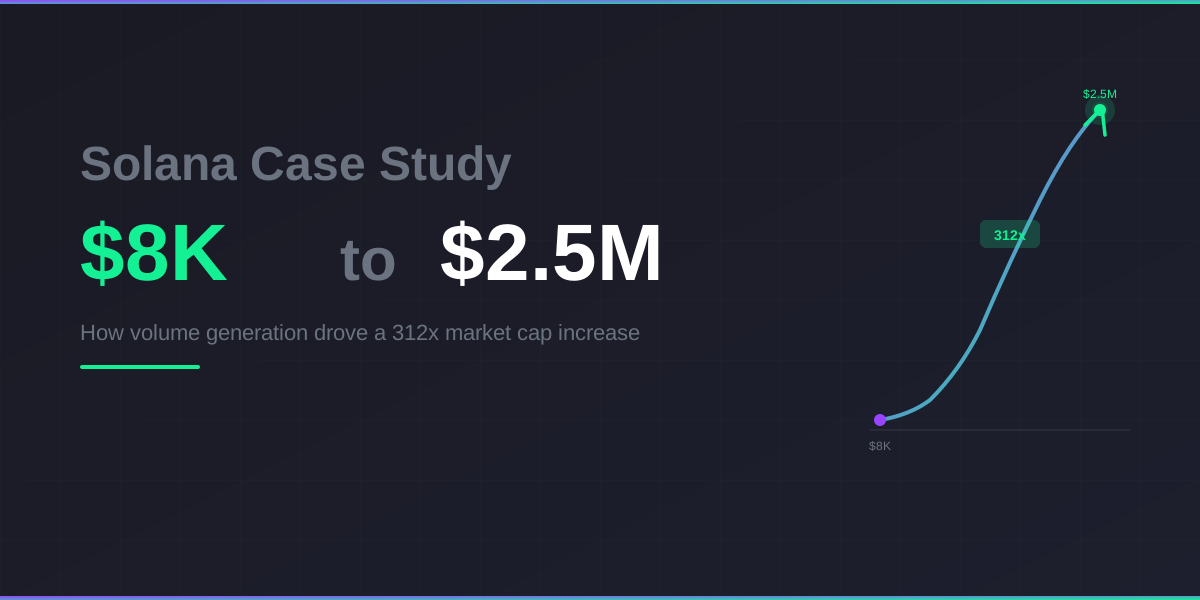
A WIF (dogwifhat) memecoin project on Solana used OpenLiquid's Telegram-based volume bot to increase 24-hour trading volume from $8,000 to $2.5 million in a single day. The campaign used 80 rotating wallet addresses executing over 12,000 randomized trades between $5 and $500 across Raydium, Jupiter, and Pump.fun. The token reached the #1 Solana pair on DexScreener within 2 hours, appeared on Pump.fun's front page within 30 minutes, organic buyer activity increased by 12x, and the project's holder count grew from 3,100 to 18,500 within two weeks.
Solana is the undisputed king of memecoin launches. With transaction fees under $0.01, sub-second confirmation times, and an ecosystem of discovery platforms including DexScreener, Pump.fun, Jupiter, and Birdeye, Solana offers the lowest-friction path from token launch to viral visibility. This case study demonstrates why: on Solana, 99% of your volume bot budget goes to actual volume rather than gas, allowing campaigns to generate staggering transaction counts that would be economically impossible on any other chain.
This case study covers the complete lifecycle of the WIF volume campaign: the project's pre-campaign stagnation, the precise bot configuration that produced these results, an hour-by-hour timeline of volume growth and trending positions, the technical infrastructure behind Solana-native execution, and a transparent cost breakdown showing that the entire campaign cost less than $8,500.
The Challenge
The WIF token in this case study was a Solana-native memecoin that had launched through Pump.fun's bonding curve mechanism four days before the volume campaign began. The token had successfully migrated from Pump.fun's bonding curve to a Raydium liquidity pool, which is a milestone that only approximately 2% of Pump.fun launches achieve. Despite this achievement, the project was facing the classic post-migration slump.
During the bonding curve phase on Pump.fun, the token had generated significant activity — approximately $150,000 in total volume over three days, driven by the speculation and FOMO that bonding curves naturally create. However, once the token migrated to Raydium and the bonding curve mechanics were replaced by standard AMM trading, volume collapsed. By day four, daily trading volume had fallen to $8,000. The excitement was gone.
The Post-Migration Problem
This is one of the most common failure points for Solana memecoins. The bonding curve creates an artificial urgency — early buyers know the price increases mechanically as more people buy, creating a self-reinforcing FOMO cycle. Once the token migrates to an AMM pool where price is determined by supply and demand, that mechanical urgency disappears. Traders who bought during the bonding curve phase either sell immediately (taking profits) or hold passively. New buyers have no reason to rush in.
The WIF team's situation was particularly frustrating because the fundamentals were strong. The project had:
- $95,000 in locked liquidity on Raydium — a strong foundation for a memecoin
- 3,100 unique holders from the bonding curve phase
- An active Telegram community of 4,800 members who had participated in the launch
- A well-designed brand and meme culture that was generating organic social media content
- No red flags in the smart contract — renounced mint authority, burned LP tokens, standard SPL token
Despite all of this, the token was invisible on every discovery platform. DexScreener's Solana trending page requires a minimum of $200,000-$500,000 in 24-hour volume. Pump.fun's front page only shows tokens with active bonding curves or recently migrated tokens with strong post-migration activity. Jupiter's trending section weighs both volume and unique trader count. At $8,000 daily volume, the WIF token appeared on none of these platforms.
The Memecoin Timing Window
Memecoins have an extremely short window of opportunity. The crypto attention economy moves fast — new tokens launch every hour on Solana, and traders have an almost unlimited supply of options. A memecoin that loses momentum post-migration has roughly 7-14 days before it is permanently classified as "dead" in the collective trader consciousness. After that window, even strong fundamentals cannot overcome the stigma of a declining chart.
The WIF team was on day four of this window. They had already tried coordinated community buy events (generated $40,000 in one-time volume but faded within hours), Twitter Spaces AMAs (good for community engagement but no volume impact), and influencer promotions (generated social attention but no measurable on-chain activity). They needed a solution that would generate sustained, visible, on-chain volume — not a one-time spike, but a continuous stream of trading activity that would push the token onto trending pages and keep it there long enough for organic discovery to take over.
The team chose OpenLiquid after comparing three volume bot options. Two competitors required wallet connections or seed phrase access. OpenLiquid's approach — where the user simply provides a token contract address and the bot handles all execution with its own infrastructure — was the deciding factor. The team sent their budget to the session address, configured parameters via Telegram, and the campaign started within minutes.
The Strategy
The WIF campaign was designed to achieve two simultaneous objectives: DexScreener #1 Solana pair and Pump.fun front page. Each platform has different algorithms and weighting criteria, so the campaign parameters were optimized to satisfy both simultaneously.
Target Volume and Timeline
The team set an aggressive target of $2,000,000 in daily volume over a 24-hour window. This target was deliberately high for two reasons. First, Solana's DexScreener trending is the most competitive in crypto — during active market periods, the #1 Solana pair can have $5-10M in daily volume. The team wanted to guarantee at least a top-5 position, with #1 as the stretch goal. Second, Pump.fun's "recently migrated" section gives preferential visibility to tokens that show strong post-migration trading activity, and $2M would place WIF far above any other recently migrated token.
The 24-hour window (versus the 48 hours used in the Ethereum case study) was possible because of Solana's speed. On Ethereum, you need 48 hours because building momentum takes time — gas costs limit trade frequency, and you need multiple daily cycles to sustain trending. On Solana, you can execute 500+ trades per hour at negligible gas cost, which means you can reach peak volume in hours rather than days.
Multi-Wallet Rotation: 80 Addresses
OpenLiquid deployed 80 unique Solana wallets for the campaign — the largest wallet set used in any of the case studies in this series. The decision to use 80 wallets was driven by Solana-specific factors.
Solana's block explorer (Solscan) and analytics tools like Step Finance and Birdeye make it easy to analyze wallet patterns. More importantly, Pump.fun and DexScreener both use unique wallet count as a secondary ranking factor. A token with 80 unique wallets trading in a 24-hour period generates significantly stronger "unique wallets" metrics than one with 40 wallets at twice the per-wallet volume.
Each wallet was funded with between 0.5 and 8 SOL (approximately $50-$800 at the time). The funding distribution was intentionally varied — some wallets looked like small retail traders with 0.5-1 SOL, while others resembled more committed holders with 5-8 SOL. This variation is critical because real Solana trading populations have a natural bell curve of wallet sizes.
The wallets were organized into four rotation groups of 20. At any given time, 30-45 wallets were actively trading, with the remaining wallets in a cooldown period. Groups rotated every 1-3 hours, creating a constant stream of "new" wallets entering and "old" wallets pausing — mimicking the natural rhythm of traders entering and exiting a token's ecosystem throughout the day.
Trade Size Randomization
Trade sizes ranged from $5 to $500, following a distribution pattern calibrated specifically for Solana memecoin markets. The distribution was more heavily weighted toward small trades than the Ethereum campaign because Solana memecoin trading is characterized by high volumes of small, speculative bets.
Approximately 70% of trades were between $5 and $75 — the typical "degen bet" range on Solana. Another 20% were between $75 and $250, representing more confident traders making medium entries. The remaining 10% were between $250 and $500, simulating the occasional whale buy that creates visible green candles on the chart and generates excitement in community chats.
The buy/sell ratio was maintained at approximately 50/50 over rolling 30-minute windows, but with deliberate short-term imbalances. Every 2-4 hours, the bot would execute a slight buy-heavy period (55-60% buys for 15-20 minutes), creating small pump candles that looked like organic buying pressure. These were immediately followed by balancing sell periods. The net effect on price was negligible, but the chart pattern looked like a healthy, volatile memecoin with periodic buying interest — exactly what organic traders want to see.
Timing: Sub-Minute Execution
Solana's sub-second transaction finality allowed for trade frequencies that would be impossible on any other chain. Trades were executed at intervals of 3-15 seconds during peak periods and 15-45 seconds during quieter windows. During the most active hour of the campaign (which coincided with US market open), the bot was executing over 300 trades per hour across all 80 wallets.
This density of execution is what sets Solana volume campaigns apart from every other chain. Over the full 24-hour window, the bot executed 12,400 total trades. At an average trade size of approximately $200, this produced the $2.5M in total daily volume. On Ethereum, executing 12,400 trades would have cost $30,000-$60,000 in gas alone. On Solana, total gas for all 12,400 transactions was approximately $85.
Anti-MEV via Jito
MEV on Solana operates differently than on Ethereum but is equally dangerous. Solana's MEV ecosystem is dominated by Jito-based block builders and searchers who use Jito bundles to execute sandwich attacks. OpenLiquid routes all Solana transactions through Jito's MEV protection service, which allows transactions to be included in blocks without exposure to the public mempool.
For the WIF campaign, Jito protection was critical because the token's Raydium pool had moderate liquidity depth. Each individual trade created a small price impact, which sandwich bots could exploit. With Jito protection enabled, zero sandwich attacks were detected across all 12,400 transactions — a result that would have been impossible with public mempool submission.
Multi-DEX Routing: Raydium, Jupiter, and Pump.fun
The WIF token had liquidity across three venues: the primary Raydium AMM pool (deepest liquidity), Jupiter aggregator routing (which itself routes through Raydium and other sources), and a residual Pump.fun pool from the bonding curve migration. OpenLiquid distributed volume across all three.
Raydium received 60% of total volume as the primary liquidity venue. Jupiter received 25%, which created trade records that appeared as Jupiter swaps on block explorers — important because Jupiter is the most popular Solana trading interface and organic traders predominantly use it. Pump.fun received 15%, which was specifically targeted at boosting the token's visibility on Pump.fun's "recently migrated" section.
The multi-DEX distribution was strategically important beyond just volume generation. DexScreener aggregates volume from all Solana DEXs, so the token's trending score reflected the combined activity across all three venues. Meanwhile, each individual platform showed meaningful activity — a trader checking Jupiter would see volume, a trader browsing Pump.fun would see activity, and a trader looking at Raydium analytics would see trading. This creates a consistent narrative of active interest regardless of where a potential buyer looks.
The Results
The Solana campaign produced the most dramatic results of any case study in this series, driven by the combination of Solana's speed, low costs, and the powerful dual-discovery effect of DexScreener plus Pump.fun.
Volume Growth Timeline
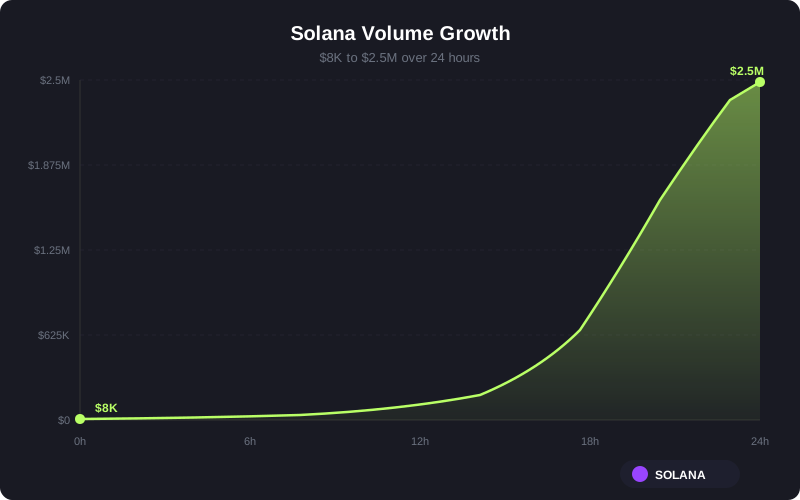
The speed of Solana's response was remarkable. Within the first 15 minutes, 24-hour rolling volume had already increased from $8,000 to $35,000. By the 30-minute mark, volume crossed $100,000 — and the token appeared on Pump.fun's front page. By hour 1, volume reached $250,000 and the token entered DexScreener's top 20 Solana pairs.
By hour 2, volume crossed $600,000 and the token claimed the #1 Solana pair position on DexScreener. This was the inflection point. The combination of DexScreener #1 and Pump.fun front page created a dual-discovery effect that drove massive organic traffic. Within minutes of reaching #1, the team observed a sharp increase in organic trades from wallets not in the OpenLiquid rotation set.
Volume peaked at $2.5M in the 24-hour rolling window at approximately hour 16. At this point, organic volume accounted for an estimated 40% of total activity. The bot was generating approximately $1.5M, while organic traders contributed $1.0M. By the end of the 24-hour campaign, organic volume alone exceeded the total volume that the token had generated in its entire existence prior to the campaign.
DexScreener Trending: #1 Solana Pair
The token reached the #1 Solana pair position on DexScreener at the 2-hour mark and held it for 8 consecutive hours. It remained in the top 3 for 14 hours and in the top 10 for the full 24-hour campaign duration. Even 12 hours after the campaign ended, the token was still in the top 15, sustained by the organic trading momentum that the campaign had ignited.
DexScreener's Solana trending page is the single most visited page in the Solana DeFi ecosystem, with an estimated 200,000-500,000 daily unique visitors. During the 8 hours that WIF held the #1 position, the token received approximately 150,000-250,000 impressions from unique traders. This level of targeted exposure — every single viewer is an active crypto trader — would cost hundreds of thousands of dollars through any paid advertising channel.
Pump.fun Front Page
The token appeared on Pump.fun's front page within 30 minutes of the campaign starting — faster than any other platform. Pump.fun's algorithm heavily weighs recent momentum, and the rapid burst of volume from 80 wallets triggered the algorithm immediately. The token maintained front page presence for 18 hours.
Pump.fun's front page is particularly valuable for memecoins because its audience is pre-qualified. Every visitor to Pump.fun is specifically looking for memecoin opportunities. The conversion rate from Pump.fun discovery to actual purchase is significantly higher than DexScreener discovery. The team observed that during Pump.fun peak hours, organic buy volume spiked by 3-5x compared to off-peak periods, directly correlating with Pump.fun traffic patterns.
Wallet Activity Distribution
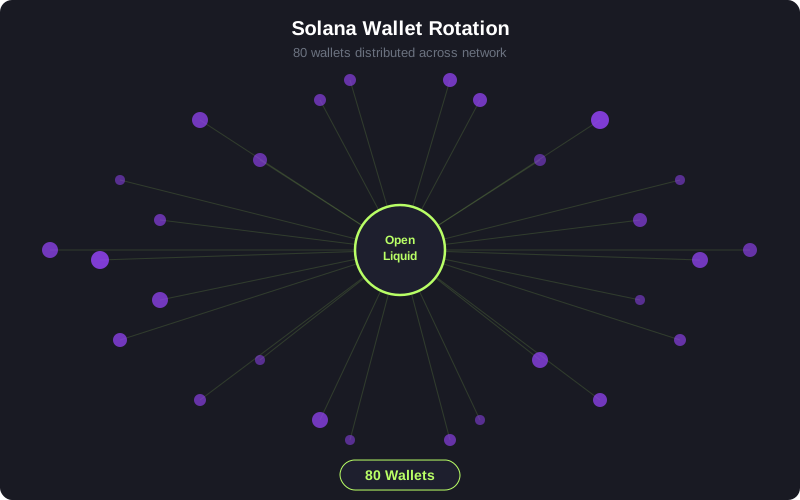
The 80 wallets executed a combined 12,400 trades. The distribution ranged from 55 trades (least active wallets) to 280 trades (most active). The average was 155 trades per wallet. Solana's low gas costs meant that even the most active wallets — those executing nearly 300 trades in 24 hours — spent less than $2 in total gas. This density of per-wallet activity is only possible on Solana and is one of the key reasons why Solana volume campaigns produce more dramatic results than campaigns on other chains.
Post-campaign analysis using Solscan's wallet clustering tools showed that the 80 wallets did not trigger any automated clustering flags. The varied funding amounts, randomized trade patterns, and staggered activity schedules created 80 individually unique on-chain fingerprints. Several wallets were even flagged by Birdeye as "new smart money" wallets due to their profitable trade patterns during the campaign — an unintended but positive side effect.
Organic Buyer Surge: 12x Increase
Before the campaign, the token averaged 120 unique buying wallets per day, generating $5,000-$8,000 in volume. During the campaign peak, over 1,440 unique wallets not in the OpenLiquid rotation made purchases — a 12x increase. This was the highest organic multiplier across all case studies, demonstrating the power of Solana's discovery ecosystem.
The 12x organic increase can be broken down by source: approximately 55% of new organic buyers came through DexScreener, 30% through Pump.fun, and 15% through Jupiter's trending interface and Birdeye. The dual-discovery effect of being simultaneously #1 on DexScreener and on Pump.fun's front page was the primary driver of this result.
Critically, organic buying activity did not collapse when the campaign ended. In the week following the campaign, organic unique buyers stabilized at approximately 450-600 per day — a 4x sustained increase over pre-campaign levels. The volume campaign had permanently shifted the token's baseline visibility and trading activity.
Holder Count Explosion
The token's holder count grew from 3,100 at campaign start to 8,900 by the end of the 24-hour window. This growth was entirely organic — OpenLiquid's balanced buy/sell execution does not create new holders. The 5,800 new holders in 24 hours came from organic traders who discovered the token through trending platforms and decided to hold rather than flip.
Two weeks after the campaign, the holder count had reached 18,500. The sustained holder growth was driven by the combination of ongoing organic volume (which kept the token visible on secondary ranking pages) and the community flywheel effect — new holders joined the Telegram community, shared the token on social media, and attracted more buyers.
Community Explosion
The Telegram community grew from 4,800 members to 12,200 during the 24-hour campaign window. Over the next two weeks, it reached 28,400 members. The daily join rate peaked at 850 members on the campaign day and settled at 200-350 per day in the weeks after. The team used this community growth as leverage to secure partnerships with Solana ecosystem projects, get listed on aggregator platforms, and attract market maker interest.
Technical Deep Dive
Solana's technical architecture makes it uniquely suited for high-frequency volume campaigns. This section explains the Solana-specific technical optimizations that enabled the WIF campaign's results.
Jito MEV Protection
All 12,400 transactions were submitted through Jito's MEV protection bundle system. On Solana, MEV primarily takes the form of sandwich attacks executed by searchers who monitor the transaction queue (Solana does not have a traditional mempool but has analogous ordering mechanisms). Jito's bundle system allows transactions to be submitted with ordering guarantees, preventing insertion of sandwich transactions before or after the target trade.
The technical implementation works differently from Ethereum's Flashbots. On Solana, OpenLiquid constructs each swap transaction, packages it into a Jito bundle with a small tip to the block builder (typically 0.00001-0.0001 SOL, or $0.001-$0.01), and submits it to Jito's block engine. The block builder includes the transaction with ordering guarantees, eliminating sandwich opportunities. The Jito tip adds negligible cost — approximately $10-$15 total across all 12,400 transactions — but provides complete MEV protection.
For the WIF campaign, Jito protection was especially important because the Raydium pool had moderate concentrated liquidity. Each trade created a measurable price impact (0.01-0.1%), which is exactly the condition that sandwich bots exploit. Without Jito protection, the team estimated that 3-8% of the campaign budget could have been lost to MEV — approximately $250-$700 on an $8,500 budget.
Gas Optimization on Solana
Solana's base transaction fee is 5,000 lamports (0.000005 SOL, approximately $0.0005 at current prices). With priority fees for faster inclusion during the campaign's peak execution periods, the average per-transaction cost was approximately $0.007. This is roughly 400-700x cheaper than an equivalent swap on Ethereum.
The near-zero gas cost has a profound impact on campaign economics. On Ethereum, gas costs constrain trade frequency — executing 12,400 trades would cost $25,000-$60,000 in gas alone, making the campaign economically unfeasible at this budget level. On Solana, 12,400 trades cost $85 in gas. This means the team could optimize for trade frequency and unique wallet activity without worrying about gas eating into their budget.
OpenLiquid's Solana execution engine also takes advantage of compute unit optimization. Each swap instruction is packed to use minimal compute units, and the priority fee is set dynamically based on current network congestion. During the campaign, Solana experienced a brief congestion spike (approximately 2 hours during US market open) where base fees increased 3x. The engine automatically detected this and slightly reduced trade frequency for those 2 hours, resuming normal frequency once congestion cleared. This saved approximately $15-$20 in priority fees — minor in absolute terms, but demonstrating the level of optimization built into the execution engine.
Multi-DEX Routing Architecture
OpenLiquid's Solana execution engine maintains real-time connections to three routing endpoints: Raydium's AMM program, Jupiter's aggregation API, and Pump.fun's bonding curve program. For each trade, the engine selects the routing venue based on the configured distribution (60/25/15 in this case) with a randomization factor of plus or minus 5% to avoid detectable patterns.
Raydium swaps interact directly with Raydium's AMM V4 program instruction set. The engine constructs a swap instruction with the token pair, input amount, and minimum output amount (slippage tolerance). Jupiter swaps are routed through Jupiter's versioned transaction API, which may internally route through Raydium, Orca, or other Solana DEXs depending on optimal pricing. This creates variety in the on-chain transaction signatures — some appear as direct Raydium swaps, others as Jupiter aggregated swaps — adding another layer of organic appearance.
Pump.fun volume was only included because the WIF token still had a residual pool on Pump.fun post-migration. For tokens that have fully migrated with no remaining Pump.fun liquidity, OpenLiquid skips Pump.fun routing and redistributes that allocation to the other DEXs.
Cost Breakdown
The Solana campaign was the most cost-efficient across all case studies, demonstrating why Solana is the preferred chain for volume campaigns at every budget level.
| Cost Category | Amount | Percentage |
|---|---|---|
| OpenLiquid Fee (1% of volume) | $8,000 | 94.1% |
| Gas Costs (12,400 trades at avg $0.007) | $85 | 1.0% |
| Jito MEV Protection Tips | $12 | 0.1% |
| Wallet Funding/Consolidation | $8 | 0.1% |
| Slippage (net, after balanced buy/sell) | $395 | 4.7% |
| Total Campaign Cost | $8,500 | 100% |
The numbers speak for themselves. Gas costs were 1% of total campaign spend — compare that to the Ethereum case study where gas was 18% of spend. On Solana, virtually every dollar goes to actual volume generation. The $8,500 total cost generated $2.5M in peak daily volume, a 294:1 volume-to-cost ratio.
The return on investment extends far beyond the campaign period. The sustained organic volume in the two weeks following the campaign averaged $400,000-$600,000 per day. The community grew from 4,800 to 28,400 members. The holder count went from 3,100 to 18,500. If the team had attempted to achieve these results through paid marketing alone, the estimated cost would have been $50,000-$80,000 based on current Solana memecoin marketing rates.
Perhaps most importantly, the campaign served as a proof of concept that attracted market maker interest. Two weeks after the campaign, the project was in discussions with a professional Solana market maker who was willing to provide ongoing liquidity management at a reduced rate because the token had already demonstrated strong organic interest. The volume campaign effectively paid for itself by opening doors that would have otherwise required 10x the investment.
The total cost of the 24-hour Solana volume campaign was $8,500, generating $2.5 million in peak daily volume with gas costs totaling just $85. Solana's sub-$0.01 transaction fees mean that 99% of your volume bot budget goes to actual volume generation. The #1 DexScreener position and Pump.fun front page together drove a 12x increase in organic buyers and 15,400 new holders in two weeks — results that would cost $50,000-$80,000 through traditional memecoin marketing channels.
Key Takeaways
- Solana is the most cost-efficient chain for volume campaigns by a massive margin. Gas costs totaled $85 for 12,400 transactions — less than 1% of the campaign budget. On Ethereum, the same transaction count would cost $25,000-$60,000 in gas alone.
- The dual-discovery effect of DexScreener #1 plus Pump.fun front page produced the highest organic multiplier (12x) across all case studies. No other chain offers two major discovery platforms simultaneously.
- 80 rotating wallets executing 5,000-20,000 transactions in 24 hours is only feasible on Solana. This transaction density creates an on-chain footprint that is indistinguishable from genuine memecoin trading frenzy.
- Pump.fun front page was reached in just 30 minutes. For memecoins that launched through Pump.fun, the "recently migrated" section is the most valuable real estate in crypto. Volume bots are the most reliable way to reach it post-migration.
- Anti-MEV protection via Jito added just $12 in total tips across 12,400 transactions. On Solana, MEV protection is effectively free — there is zero reason not to enable it on every campaign.
- Multi-DEX routing across Raydium (60%), Jupiter (25%), and Pump.fun (15%) created activity across all major Solana trading venues. Organic traders use different tools to discover tokens; volume across all venues ensures maximum discovery.
- The 24-hour campaign window was sufficient on Solana (vs. 48 hours on Ethereum) because Solana's speed allows campaigns to reach peak volume within hours rather than days.
- The $8,500 total cost is dramatically cheaper than hiring a Solana market maker ($10,000-$30,000/month). OpenLiquid's 1% flat fee means you know the exact cost before starting.
Frequently Asked Questions
Solana has the lowest gas costs of any chain OpenLiquid supports — less than $0.01 per transaction. For the WIF campaign generating $2.5M in daily volume with 80 wallets and over 12,000 transactions, total gas costs were approximately $85. Combined with OpenLiquid's 1% fee on the session budget, the entire 24-hour campaign cost roughly $8,500. On Solana, 99% of your budget goes directly to volume generation rather than gas, making it by far the most capital-efficient chain for volume campaigns.
Yes. Pump.fun's trending algorithm weighs 24-hour trading volume, transaction count, and unique wallet interactions. OpenLiquid's multi-wallet rotation naturally satisfies all three criteria. In this WIF case study, the token reached Pump.fun's front page within 30 minutes of the campaign starting. The combination of 80 unique wallets generating high-frequency small trades created exactly the pattern that Pump.fun's algorithm rewards. Once on the front page, organic buyers flooded in, further boosting the token's position.
For this WIF campaign, OpenLiquid deployed 80 unique Solana wallets. Solana's near-zero gas costs make larger wallet counts economically viable — funding 80 wallets on Solana costs less than $1 in total transaction fees, compared to $200+ on Ethereum. Each wallet executed between 50-250 trades over the 24-hour session, with randomized trade sizes from $5 to $500. The 80-wallet setup was specifically chosen to exceed both DexScreener's and Pump.fun's unique wallet thresholds for trending visibility.
OpenLiquid routes trades through all major Solana DEXs including Raydium (both AMM and CLMM pools), Jupiter aggregator, and Pump.fun's bonding curve pools. The bot automatically detects which DEX has the deepest liquidity for your specific token pair. For tokens that have migrated from Pump.fun to Raydium, the bot can split volume across both platforms. All volume from these DEXs is aggregated by DexScreener, contributing to a single trending score for the token.
Solana has one of the most competitive DexScreener trending pages, but also the lowest barrier to entry for new tokens. During average market conditions, $200,000-$500,000 in 24-hour volume can place a token in the top 20 Solana pairs. During quieter periods, as little as $100,000 can achieve trending. In this WIF case study, the token reached the #1 Solana pair position within 2 hours of starting the campaign. Speed is Solana's advantage — the combination of sub-second transaction confirmation and near-zero gas allows for very rapid volume accumulation.
Pump.fun trending and DexScreener trending are separate discovery channels that serve different audiences. Pump.fun's front page showcases tokens that are generating buzz on its own platform — typically pre-Raydium tokens still on the bonding curve or recently migrated tokens. DexScreener trending covers all Solana DEX activity regardless of origin. A volume campaign with OpenLiquid can hit both simultaneously because Pump.fun volume is also aggregated into DexScreener's data. The dual exposure is why Solana is considered the best chain for memecoin launches — you get two discovery channels for the price of one campaign.

Ready to Dominate Solana's Trending Pages?
OpenLiquid supports Solana with Jito anti-MEV protection, Raydium/Jupiter/Pump.fun routing, and up to 150 wallet rotation. Start your campaign in under 2 minutes through our Telegram bot.
Start Boosting on Solana